Showing posts with label Australia. Show all posts

Saturday, 25 June 2016

Conversations with your Drunk Uncle - The Meaning of Brexit for Australia


There's a large lot to swallow for political types in yesterday's Brexit vote. A lot more again for people of the left and people of Labo(u)r. But I worry we're going to wind up focussing on the wrong things again, and I worry more that we're not going to have many more chances to learn the lessons.

Because to me, the one, salutory lesson from yesterday's vote was clear: 

Had the Syrian refugee crisis not peaked when it did, Britain would not have voted to leave the EU.


This was, as much as many campaigners on either side attempted to make it not, a vote entirely about the issue of immigration. So Farage's "Rising Tide" poster was one of the key moments of the campaign. Because it was one of the few moments where one felt like the discussion was anywhere near the genuine locomotive issues for most people.

And the real message of that poster was "Turkish muslims are coming to swamp us when they too join the EU." It was perfect because it played into feelings of the EU as a kind of structure "out of control" and misaligned with traditional European national identities. But it also clearly posited "you wanna see another repeat of all these Syrians ..." dovetailing perfectly into anti-muslim sentiment, working class fears over job insecurity, and a sense that EU membership effectively means ceding control of one's national borders.

Europe is Burning, Australia Smoulders

Chatting online with European friends lately, one cannot emphasise how severely the totally unprecedented levels of Syrian refugees the continent has accomodated has led EVEN THE MOST ARDENT MUTICULTURALISTS amongst them to wonder aloud whether we've gone too far. The change has been too profound, the potential risks to our broader social fabric are seen as too great, and too real. In short, ALL the sorts of anxieties that we are all too prepared to call racism when workers exhibit them are now being voiced aloud by liberal left elites all across the continent.

And this resonates with us particularly here in Australia, where immigration and the broader multiculturalist project have become a zone from which politicans have sought to build personal agendas, where they have come to be seen as a kind of political "pet project" of the political elites that working people blame for the broader economic insecurities they are feeling.
"This was not a vote on the undeniable lack of accountability and transparency of the European Union. Above all else, it was about immigration, which has become the prism through which millions of people see everyday problems ... Young remainers living in major urban centres tend to feel limited hostility towards immigration; it could hardly be more different for older working-class leavers in many northern cities and smaller towns."
-Owen Jones, The Guardian 

Every inner city hippie type who opposes "stopping the boats" needs to heed this message, and stop listening with condescention to the people delivering it. Your outrage against "racist" immigration policies and "dog whistling" is only convenient to you because it turns your opponent's argument into a unidimensional charicature.


Because if you're fighting racists then you've already won the argument, right? Well that only works at Uni in debating club. Try retrofitting that into a world where you need to win over actual living, breathing, sentient beings before you can win ANYTHING and it's simply yourself and your own argument that wind up losing.

We're mapping a whole raft of different phenomena here, but one of the crucial ones for Labor people in Australia is that we URGENTLY need to start showing that we understand the economic frustrations, but more importantly we need to give people a much better sense that we have an actual plan capable of addressing them.

Who owns "globalisation"? The left turns up to protest it vehemently. The populist right pillory it as ceding control of nationhood and economic independence, and millions of people worldwide suspect it's a process that directly threatens their best interests. There was a time when Labor would have done anything to attach itself to a mast of that size, but that it would be reticent to do so today tells you how badly our political culture has declined. Any Keating-scale headline policy would be eschewed by modern federal Labor as too ambitious, and Keating's experience would be cited.

But did we ever bother going through what Keating actually got wrong in how he sold his agenda before we declared big agendas "too difficult". For this author, no, and not by a very long way.

Modern Australians - Keating's Illegitimate Offspring

Everyone remembers but nobody understands the meaning of Keating's "banana republic" speech. It was a specific call to "open the economy up, or become yesterday's backwater". And it was an absolutely essential prescription. If you don't remember growing up in Australia in the early 80s, you won't properly remember a time when "Australian" meant "like the rest of the world, but a bit shitter", when the "cultural cringe" was a real phenomenon induced in you every time "Australian-ness" was ever invoked on a global stage.

That backward, insular Australia died in public policy terms at the end of Keating's political vorpal sword, but he totally failed to bring the people most impacted by those policies to see and understand their benefits. By the time he'd gotten around to "the recession we had to have" - and that was really just another (worse) way of phrasing the banana republic speech - nobody was listening to the policy headlines because they were too busy bearing its negative impacts.

We need to spend some actual time talking to people about why an open, not a closed, economy is crucial for Australia to prosper - being a huge landmass with a tiny domestic economy in global terms, it's not a difficult argument to make. Your kids will have a better future in a more open Australia.

But we very urgently need to understand that for so long as workers feel that their current job insecurity is the coin used to purchase that future then they are not going to sign on to the vision. And they are going to take every opportunity to blacken the eyes of the "political classes" untill we show some sign that we appreciate this.

Calling people racists who are afraid that we've ceded control of our immigration policy is completely misguided. Because failing to understand what's actually going on that comprehensively almost always ensures you'll seek out the least effective response. You're most certainly going to respond with the least persuasive discourse for your actual target audience.

Explaining to people how this is neither true, nor the source of their insecurity should be the easiest thing in the world if political classes took their role as PERSUADORS seriously. Instead our political cultures seek out great "revelators" and autodidacts, our internal party processes do everything BUT reward persuasion and argument as a skill. Why the hell would you need either of THOSE qualities to secure an ALP safe seat preselection? All you need is the tap from George Seitz ...

We urgently need to change this tune, because there are as many people in Australia as in the UK looking for something more substantial than just putting Pauline Hanson back in Parliament to bash us about the head with. Who can say for sure they'll never have a wrecker's moment on a Brexit scale?

And who would declare they entirely blame them?

Tuesday, 5 January 2016

High-Speed Rail is a Dumb Idea for Australia - but a brilliant one for Victoria

The (Shaky) Case for HSR in Australia


The 2013 High Speed Rail in Australia Study Phase 2 Report (large pdf file) was delivered in 2012 as a preliminary study towards constructing High-Speed Inter-Capital Rail along the Australia's eastern seabord.

The study proposed a service allowing for conventional High Speed Rail express journeys from Sydney to Melbourne taking 2 hours and 44 minutes. The cost of the proposed project was
"about $114 billion (in 2012 terms), comprising $64 billion between Brisbane and Sydney and $50 billion between Sydney, Canberra and Melbourne." 
The study predicted
"By 2065, HSR could attract 40 per cent of inter- city air travel on the east coast and 60 per cent of regional air travel (primarily long regional). On the three main sectors, Sydney-Melbourne, Sydney-Brisbane and Sydney-Canberra, HSR could attract more than 50 per cent of the air travel market." 
The current flight time from Sydney to Melbourne is 1 hour and 35 minutes. So allowing for the extra transfer time required with air ravel, where one generally arrives an hour before one's flight after traveling half an hour or so on a freeway, HSR would APPEAR to be relatively time competitive to its alternative mode.

But consider this - Sydney's current airport rail link carries just 17% of traffic to the airport. The alternative mode via taxi or private vehicle is both cost and time UNCOMPETITIVE with rail transit. Travelers know they'll still need to factor in getting to their hotel or wherever once at their ultimate destination and lugging their bags via some means to the train station. Somehow rail always seems sexier as an idea than as a reality to people.

The Phase Two Report numbers seem intuitively optimistic to me. I just can't see business travelers, who make up the majority of this route shifting to train travel, where the company gets their cab fare at either end anyway seeing the imperative to travel by rail. However they are backed up by international research into mode-share for HSR versus air over similar distances and volumes.

But the Phase Two Report makes it explicit; "A key (benefit) component is the assessment of time savings for travellers across their full journey including travel time, waiting time, check-in time and access time, with adjustments for the inconvenience of having to change modes."

The gains here all accrue to the private sector, but require a huge public subsidy to facilitate them. That should be an enormous warning sign to any elected official that their project is about transferring value FROM the public purse.

And that private benefit will accrue on, again by the report's own numbers, just 18,760 Melbourne-Sydney trips a year. For a $50bn pricetag. 
Over a decade, that's a 0.26 million dollar public subsidy PER TRIP. This is just ludicrous public economics. 
Let's be clear - our biggest policy problem in Australia worthy of $50bn of public funds is NOT the higher emissions caused by people traveling from Melbourne to Sydney by air.

Nor is it the amount of time these people spend getting to or from the airport a handful of times a year on average. Air transport emissions are an issue of certain public concern obviously, but in the greater pantheon of public spending demands, it isn't remotely on the radar.

But the straining of our eastern capital cities IS. Enabling regional commuter centers and allowing us to end the process of urban sprawl that leaves the city's most needy consigned to urban ghettoes with poor social services and networks IS, at least for this commentator somewhere close to the top of our list of needs.

INTER-CAPITAL HSR

- BUILDING THE WRONG NETWORK 

And so it gets worse.

Again the Phase Two Report states "To achieve the target journey time of under three hours for Sydney-Melbourne, an average journey speed of approximately 300 kilometres per hour would need to be achieved. This would require a system capable of a maximum operating speed of 350 kilometres per hour, to allow for some slower sections of track."

But the study also clearly articulates that these speeds won't be possible if the network is also used for commuter travel into suburban centres. IE this whole things assumes the trains are EXPRESS Melbourne to Sydney which COMPLETELY DENUDES HSR OF ONE OF ITS KEY BENEFITS - FACILITATING THE GROWTH OF SATELLITE COMMUTER TOWNS.

If the speed of the network is reduced to 250km/h then the Sydney-Melbourne journey time balloons to three hours and seventeen minutes - and over four hours at 200 kph.

So, we can't have a network that does both - intercapital and commuter HSR. And because I see all the REAL PUBLIC benefits from HSR as accruing from a commuter network, I believe every sane advocate of HSR in this country needs to be clamouring for an immediate re-assessment of the project's priorities to create a COMMUTER network as first priority, one that could be expanded into an inter-capital network at a later date.

COMMUTER HSR FOR VICTORIA 

- BUILDING THE RIGHT NETWORK 

Towards that end, this week we're looking at what an effective HSR network enabling commuter travel into MELBOURNE might look like, and what benefits would accrue to the state of Victoria from such a network.

Proposed Victorian High-Speed Rail Network in Stages

OBJECTIVE
To best enable commuter HSR to maximise the number of commuter journeys possible into Melbourne from effective satellite regional centres.

COSTING
This proposal is costed on the basis of the Phase 2 Study estimate of construction costs of $56m per kilometer on its proposed Shepparton-Melbourne section. This incorporates a higher cost of getting HSR in to Melbourne, but under my model if we use the existing RRL tracks/reservation the cost per kilometre may be signifcantly lower. It should also be noted that the Phase 2 Study costed track graded to run trains capable of 350 km/h. My figures only anticipate running commuter services at the lower speeds of 250 km/h, requiring track capable of max 300 km/h. So, my actual figures should be either be CHEAPER than those shown if a lower capacity track were used, or my time savings HIGHER than those indicated if we had higher capacity track.

The total construction cost of the proposal at face value is $17.03 bn. Allowing for some featherbedding, we can comfortably state the project could be delivered for under $20 bn.

FUNDING
Instead of spending $50bn on Melbourne-Sydney HSR, Canberra should jointly fund this $20bn project with the State of Victoria. It would therefore represent a $10bn investment towards the long-run development of Melbourne-Sydney HSR. Victoria would then need to find $10bn, which could easily be done with a combination of value capture methods, debt, or even a one-off "Melbourne congestion levee" implemented probably best via a Melbourne Water surcharge on everyone in Melbourne, Ballarat and Bendigo who all stand to gain from the proposal.

ROUTES/STAGING
In line with the above objectives, our best potential established regional commuter centres - by distance to Melbourne - are Ballarat, Geelong and Bendigo. At present PTV's plans for Geelong involve a long-run electrification of the route, without any clear timeline. No upgrades are planned for the Ballarat or Bendigo routes.

I propose instead, because all these services now run on dedicated Regional Rail Link tracks through suburban Melbourne, that the Ballarat and Geelong routes be completely replaced by HSR in to Southern Cross Station.

Instead of replacing the Bendigo line, which currently runs direct from Castlemaine-Melbourne and only uses Regional Rail Link from Nth Melbourne Station to Southern Cross, it is proposed to create a new HSR Bendigo-Ballarat route replacing the existing track section Bendigo through Castlemaine and with a new dedicated HSR track running via one of two routes to Ballarat, depending on whether Daylesford is included in the network.

ISSUES
Under this proposal, I envisage V/Line services continuing with existing V/Locity rolling stock on the existing Bendigo line as far as Malmsbury - that being the northernmost station that wouldn't receive HSR, although it may only be economic to continue it as far north as Kyneton. Under this proposal, this line would to return to sharing the network with Metro trains between North Melbourne and Southern Cross, though this would be a relatively minor issue.

A bigger issue would be how to have Metro trains service the planned future Melton line electrification if the RRL tracks were ripped up for HSR. One I'll set aside because it's kind of boring, but it's one that would need to be solved for Tarneit and Wyndham Vale Stations also.

The only major question posed by route selection is whether the increase in travel time to and from Castlemaine and Bendigo that would result from including a Daylesford stop on the route would be justified. At the estimated increase in time of just nine minutes, this would seem justified based on the potential to Victoria's tourism industry of being able to take a one hour train trip to Daylesford.

As stated, both the Ballarat and Geelong lines would be replaced in their entirety using current alignments and easements, with the sole exception being the dog-leg placed in the Melbourne-Geelong route to allow for the inclusion of Avalon Airport.

Provision of heavy rail to Avalon remains a major public policy concern in Victoria, and the deviation would add a matter of around three minutes to the journey, so this is a negative-brainer.

Another issue will be the need for planning and provision of metro-style public transport infrastructure in regional centers. In fact the current Victorian government has commenced tentative planning towards this end in some centers. It would need to be coordinated and consider how metro services in Geelong in particular would interact with the HSR, where HSR tracks in Geelong would replace notionally "metro" ones in the north of the city. A large part of the featherbedding in my costing is to allow for necessary track duplication works (possible with double-decking) into urban areas.

STAGE ONE - Ballarat to Southern Cross

High-Speed rail for Victoria -
Stages One (purple) and Two (blue)

Stops
Ballan
Bacchus Marsh
Melton*
Rockbank*
*to be serviced by Metro in future

Distance
121.8km 

Projected Cost
$6.8bn 

Time Savings
Please note these times are based on existing train travel times, although for our purposes a better comparison might be with current motor vehicle transit times, these are almost impossible to extrapolate meaningfully into the future.

Because Stage Three of the project envisages Bendigo trains running express from Ballarat to Melbourne, passengers will at that point be offered an even speedier express service to Melbourne.

It is envisaged that as per present services, demand to Melton and Rockbank would not initially warrant all services stopping there. Accordingly, Ballarat-Melbourne travelers would have a choice of "two stop" or "four stop" services, and ultimately also an express service.

Ballarat - Melbourne with four stops via HSR travel time 48 minutes down from 72. Save 24 minutes.
Ballarat - Melbourne with two stops via HSR travel time 42 minutes. Save 30 minutes.
Ballarat - Melbourne HSR Express travel time 36 minutes. Save 36 minutes. Travel time HALVED.

If that sort of quantum change isn't enough to induce the kind of responses we are looking for with this policy, well I'm keen to hear of any policy that could possibly do MORE...

Please note also that these time savings are predicated on speeds of ONLY 200 km/h. The likelihood of being able to build a network attaining speeds of up to 250 km/h without much incremental expense is extremely high. So these estimates are at the PESSIMISTIC end of the spectrum. The reality SHOULD be even better.

Proposed Victorian High-Speed Rail - Urban Section

STAGE TWO - Geelong to Deer Park

Stops
Lara
Little River
Avalon Airport
Ardeer*
Deer Park*
Tarneit*
Wyndham Vale*
*to be serviced by Metro in future

Distance
61.3 km new track

Projected Cost
$4.5bn 

Time Savings
As per Stage One, not all these stations demand being serviced by every train. It is envisaged travelers from Geelong would have the option of an "Express" service to Melbourne stopping only at Avalon Airport, in addition to the slightly longer services.

Geelong - Melbourne with six stops travel time 42 minutes, down from 62. Save 20 minutes
Geelong - Melbourne with four stops travel time 36 minutes, down from 62. Save 26 minutes
Geelong - Melbourne with one stop travel time 27 minutes, down from 62. Save 35 minutes. Travel Time more than HALVED.

STAGE THREE - Bendigo to Ballarat

High Speed Rail Stage Three (red), showing alternative ex. Daylesford route (light blue)
and proposed national HSR alignment (dark blue)

Stops
Kangaroo Flat
Castlemaine
Daylesford?
Ballarat
Service would run express Ballarat-Melbourne

Distance
123.5 km  via Daylesford

Projected Cost
$6.9bn 

Time Savings
Bendigo - Melbourne via Daylesford with four stops travel time 86 minutes down from 112,
save 26 minutes.
Bendigo - Melbourne ex Daylesford with three stops travel time 77 minutes down from 112,
save 35 minutes.


Directing Victoria's and Melbourne's Growth

So, the proposal would then set us up with the following:

Designated Regional Commuter Centers 
Greater Ballarat, Greater Geelong, Greater Bendigo, Lara, Little River, Ballan, Bacchus Marsh and Castlemaine.
NB I wouldn't propose significant residential development for Daylesford, where preserving and enhancing Tourism and Heritage values should be the objective.

Urban Fringe Stations with Fast Rail Access
Ardeer, Deer Park, Melton, Rockbank, Tarneit, Wyndham Vale 

Looking beyond this though, while it will be these designated commuter cities that stand to benefit most economically and socially from fast rail access to Melbourne, travel times will be reduced significantly to a vast range of regional towns that would it is envisaged retain their existing V/Line service as a shuttle to the nearest major center.

So, we should actually see benefits accrue to Swan Hill and Echuca, Ararat, Maryborough, all of which would still be a relatively short hop to being on the High Speed Network, and even further flung places on the network like Colac and Warrnambool should benefit proportionately also.

Proposed Northern Victorian High-Speed Rail with V/Line Shuttles (yellow)
and proposed national HSR alignment (blue)

Proposed Southern Victorian High-Speed Rail with V/Line Shuttles (yellow)

What About Freight?

Ripping up the tracks to accomodate the HSR should be easy enough, but what about freight to places like Ballarat and all the towns they serve? I don't believe it has been attempted anywhere in the world, but there would be no reason not to run a high speed freight service along this route also as per demand, in fact there would be a lot of reasons for.

Doing so would be the prelude to one way a national HSR may someday happen. We've seen the cost-benefits don't stack up, but they MIGHT if we could incorporate inter-capital HSR freight as a means to removing a large amount of the truck traffic from our highways, resulting in lower maintenance, fewer accidents, air particulates, etc.

Not to mention we'd possess an absolute world beating eastern seabord freight network by way of national competitive advantage. Because doing this initially Sydney-Canberra ought to make sense on a similar basis to the above, and if we've gone as far as Bendigo, building the extra stretch in the middle might make sense down the track.

I dunno. To my eye, all of this seems to offer a lot more concrete than any of the nebulous and largely non-public benefits we've yet heard of associated with building a national HSR network. What do readers think?

Wednesday, 24 June 2015

Zaky Mallah's Question Should be Answered, not Dismissed ...

... although Q&D would scarcely be an unsuitable name change ...

Zaky Mallah may not have phrased it to the media's usual standards of perfection. If the baseball cap didn't give it away, Zaky's twitter tonight announced it was "time for a holy ciggi" having seen what News Corp have in store for him tomorrow. So erudition may not always be to the fore here, but he's written a reasonably spirited defense of himself HERE, and good on him for not running from an issue that's going to have him media fodder for weeks to come

But if you read it as any sane person would, saying "attitudes such as the Minister's are what is driving young muslims in Australia into the arms of ISIS" is a perfectly reasonable and easily defensible statement.


And the response (including that of Tony Jones) has been yet another textbook study in how to radicalise Muslim youth. When they tell you to your face, "the way you are carrying on is driving people to Islamic State", is this guy asking to have his citizenship cancelled or is he trying to actually contribute to MODERATING the debate?? 

But it's so much easier to pretend he spoke in radical partisanship because that fits a neat stereotype. And therefore we are justified in ignoring, invalidating and dismissing a contribution to the topic at hand of some insight. We would stick our heads in the sand at the very moment one of the muslim youths we are so concerned to de-radicalise offers us insight that should help our efforts.

Jump down the guy's throat, censor him, cut him off just because he used the word ISIS. We all deserve to get blown up, and no doubt some of us will if this is our approach to reaching out to radicalised muslim youth.

Just type the words "Zaky Mallah" into twitter and check out how much racist and offensive bile the citizens of our nation have stored up for him. And imagine yourself a young muslim doing the same. Look at the deliberately blasphemous pictures insulting your religion. Look at the comments that all muslims should be deported. 

Now tell me that Andrew Bolt and his ilk aren't the best recruiters Islamic State has in this county.

Sunday, 24 May 2015

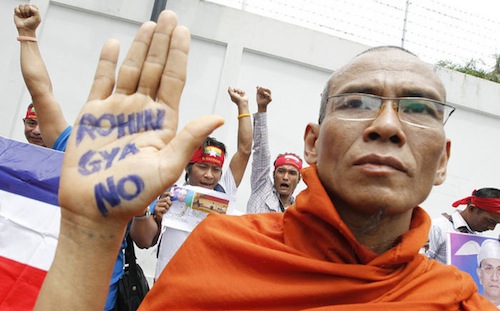
Now, can we talk about Malaysia again? The Rohingya and Australia's Asylum-Seeker Mythologies

There's been little (err, nothing actually) from the Dalai about the actions of his inherently-peace loving co-religionists in the ethnic cleansing of Rohingya in Myanmar/Burma/which way is the wind blowing today?

Donations can be made directly in support of the Rohingya people through MuslimAid.
PLEASE CLICK HERE TO HELP THE ROHINGYA

The international refugee regime, we are continually told, usually without any reference to the actually ample evidence, is broken. And nations across southeast Asia have had a very salutary reminder to that effect this week.

From an Australian perspective, there was no moral leg left to stand on when Malaysia, Indonesia and Thailand all refused to allow boats laden with human misery in the form of thousands of asylum-seekers to come ashore. The narrative that the majority of these people are Burmese Rohingya has been countered with claims that most are in fact Bangladeshi laborers, and clearly it will take some time to sort the truth from the murk here.

But the poisonous politics of refugee movements has been sheeted home to both parties at either end of the loggerhead in Indonesia-Australia relations - and it seems clear now that this issue has become almost set like a permanent psoriasis in the relationship as a direct result of the Abbott Government's actions. (Psoriasis, by the way is an incurable condition where the body's immune system incorrectly identifies its own skin as a pathogen, which the immune system begins attempting to attack. I LIKE THIS METAPHOR!)

The Indonesian Foreign Ministry went to extraordinary lengths this week to ensure that it eked maximum moral mileage from the process, and why not? When your opponent hands you the moral high ground by dint of throwing themselves off it, what kind of fool wouldn't revel in their new status?

For Australia, this has been monumentally unedifying. Monumentally so because of the absolute lean undisguised hypocrisy our leaders have displayed. Let's put the parallels in purest black and white.

When this country was faced with an influx of asylum-seeker arrivals by boat, we screamed about the need for a "regional solution" and both implicitly and directly berated the Indonesions for not stopping the trade from their shores. The effect of Indonesia's stopping any given asylum seeker reaching Australia is a tacit agreement that they will continue to host that person in Indonesia.

In other words we are asking Indonesia to help keep these people out of Australia to avoid a given set of negatives for Australia. In doing that, we ask Indonesia to bear every single one of those negatives themselves. So the rich, first world nation with per capita GDP among the top 3 nations on earth wants to have its problems solved by their dirt-poor developing neighbour where GDP per capita is lower by a factor of nearly 20 times taking on board 100% exactly those same set of problems.

There are several mentally/morally-deficient scripts that need to run simultaneously in the background in order to sustain this indulgent fantasising. The first of which runs "Indonesia isn't a signatory to the convention, so it's not a problem, they have no obligations". This is of course only true in law. The realpolitik is that Indonesia has actually to do something to mange the situation of thousands of non-citizen itinerants in its own borders who have no means of their own to make ends meet. The costs are real.

So, basically we are saying to Indonesia "this is unfair on us, you need to help us avoid accruing the negatives associated with boat arrivals by agreeing to accrue all those negatives in Indonesia. That's our endpoint. That's our goal here." The average Indonesian must surely be left wondering about when the discussion will turn to how we sensibly therefore stop people these coming into Indonesia also. That would be rational. That would be a true "regional solution".

The image tells it all - rejecting Malaysia directly enabled the horrors of Manus Island and Nauru


This is why I will stand on a stack of lectern bibles and defend Gillard's "Malaysia Solution" as probably the best policy prescription to address irregular refugee movements that has yet been put forward anywhere globally ever. I strongly urge the ALP to return to this policy, replete with whatever enablements might be necessary to ensure constitutionality, and that should include if absolutely necessary setting aside our signature to the 1951 Convention.

Malaysia offered a far safer haven in a far more developed economy and society than any other offshore-transfer regime yet has. It offered haven largely free from detention in a muslim-majority country. And the kicker, for those who haven't yet twigged where I'm headed is of course that it offered in return for Malaysia taking 800 Australian boat arrivals that Australia woud take up to 4,000 ... wait for it ... mostly Rohingya refugees currently in camps in Malaysia.

"Fly them here to stop the drownings" is the language the Greens and the hard left assail us with. "Well, OK, then!" is the Malaysia solution's answer.

The Malaysia Solution gave very specific and direct voice to the claim the Australian people had been effectively (though perhaps disingenuously) making for years, that "we want to be generous to refugees, but only those accredited through the formal UNHCR channels."

And it was a solution that showed proper respect for the sovereignty and concerns of our regional neighbours, it gave us a role whereby the example we set we could be said to be showing real regional leadership.

And we and every other southeast Asian nation are back on the treadmill this week mouthing glib grabs about "regional solutions" being essential. Well, seriously people, get the hell on with it, then. Everyone knows what a regional solution is basically going to look like, and Malaysia gave us a pretty good template for a series of frameworks. And we already have the Bali forum to directly address this within. That forum would of course have more teeth today if it hadn't been for our hypocrisy in undermining it through our own actions, but there's no argument starting anything new would have a hope of re-setting that.

Tony Abbott has managed this week to sink this nation's moral reputation a good foot or so deeper in global sludge. I keep wondering how much gold a Gillard could have spun this week with a positive proactive framework to stop the deaths, stop the buck-passing back to the developing world, and ultimately mitigate the human suffering.

And we really do need to keep eternally reminding ourselves that's the bottom line here. Human suffering and its alleviation. Because I am damn certain that the policy prescriptions the Greens and their ilk have put forward to date do not score ahead of the Malaysia Solution under that very real and very meaningful and deeply moral benchmark.

We want to be part of this region. As a wealthy, open, tolerant nation with plenty of everything to go around, we want to share the main burden of this region's paramount humanitarian crisis, and if you doubt the Rohingya deserve that status, just Google image search the word. Watch your screen fill with nothing but grisly post-massacre photos as "peace-loving" Buddhists cart charred corpses away, that or see people sitting massed in the dirt in refugee camps by way of a pictorial account of an entire people. And ask yourself what any of these people have done more or less than yourself, other than a mere accident of their birthright to deserve it.

Can we live with any of the outcomes that currently look like playing out? Nope, Nope, Nope.

Donations can be made directly in support of the Rohingya people through MuslimAid.
PLEASE CLICK HERE TO HELP THE ROHINGYA