Showing posts with label Australian Labor Party. Show all posts

Friday, 8 July 2016

Melbourne Story - Labor Very Nearly Runs Third in its Former Bailwick at 2016 Federal Election

I've thought long and hard about this. I want to initiate this discussion, and I want all the people who might benefit from to see some of this mapped out spatially, although that's a complete tautology. Whatever.

But I don't want to have this discussion online, or at least not publicly online. There's a lot going on here, and the dust is still settling. But the reality is that the warning I sounded to the few poor souls whose throats I forced my 25,000 word essay down has essentially come to pass, and even sooner than I feared. We have all but run third in 2016 in the seat where in 2001 Lindsay Tanner secured a 48% primary vote.

So I'm not risking putting any more grist in our opponents' mill by putting any more of our ideas in the public arena. Here's the raw data. I'm extremely eager to hear anyone's spin on it, to know whether anyone can see a way forward here. Or does this essentially advise us "it's cooked, move on"?

None of the demographic trends at work show any sign of reversing, nor do they seem like the sorts of things election campaigns can really much impact. The only booths we won at the last poll were Housing Commission booths - and we still managed to lose half of those, or booths where a high Liberal vote got us over the 2PP line. Does this feel terminal, or what?

I've reproduced the images from my earlier blog post here also to help give some more historical context/trend. You'll note I've changed my methodology. Working with the area-based "lozenges" was a bit more visually engaging but an absolute pain in the digital arse. Especially when particular booths come and go from poll to poll.

These 2016 numbers of course exclude absentee and declaration votes, but the reality is those are obviously NOT going to alter the more demonstrable trends.

Anyway, I'll let the data speak for itself, and hopefully you, dear reader, may also be moved to do similarly. You know where to find me.

Melbourne FEA Booths by 2PP vote %, 2016 Federal Poll

Bright Green = GRN 50-60%, Deep Green = GRN 60%+
Orange = ALP 50-60%, Red = ALP 60%+

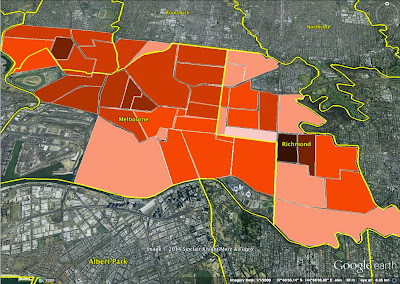
Melbourne FEA Booths by ALP Primary Vote %, 2016 Federal Poll

Pink = 10-20%, Light Orange = 20-30%, Deep Orange = 30-40%, Red = 40-50%

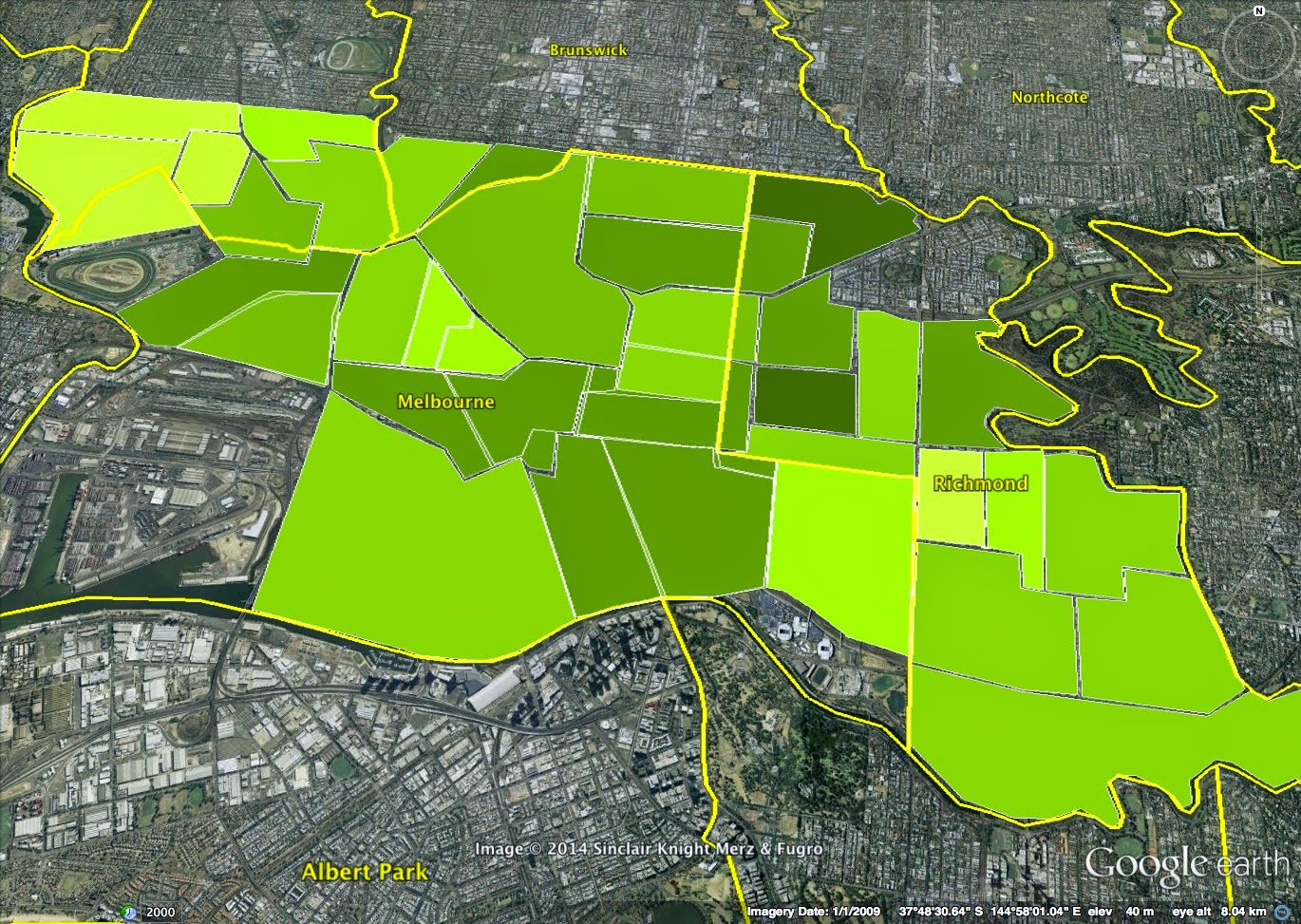
Melbourne FEA Booths by GRN Primary Vote %, 2016 Federal Poll

Pale Green = 30-40%, Bright Green = 40-50%, Deep Green = 50-60%

Melbourne FEA Booths by 2PP Swing %, 2016 Federal Poll

Pale Green = GRN+0-1%, Bright Green = GRN+1-5%, Deep Green = GRN+5%+
Orange = ALP+0-1%, Red = ALP+1-5%
Hotham Hill booth is the outlier, swinging 12% GRN

Melbourne FEA Booths by ALP Primary Swing %, 2016 Federal Poll

Pale Green = -0-1%, Bright Green = -1-5%, Deep Green = -5%+
Light Orange = +0-1%, Dark Orange = +1-5%, Red = +1-5%+

And frankly, I think this next one is one of the most interesting charts of all. And this is basically where I'm coming from when I forecast that the entire inner city is just going to be one massive three way contest in the not too distant future.

Melbourne FEA Booths where highest 1st pref swing was to the LIBERALS, 2016 Federal Poll

The remaining older charts show primary voting patterns (no 2PP) for Federal Elections 2013 and 2010 plus Melbourne State District Byelection 2012. State electoral boundaries are shown in yellow. Lighter red = lower ALP vote %. Lighter green = lower GRN vote %. Colours are consistent in their % representation across all images.

ALP Primary Vote, 2010 Federal Poll

ALP Primary Vote, 2013 Federal Poll

Indicating the huge decline in ALP votes in central, north and eastern parts of the electorate

ALP Primary Vote, 2012 State Byelection

ALP Primary Vote, 2010 Federal Poll, overlaid with State Byelection 2012

showing little shift in ALP primary vote between these polls in booths within the State District boundaries

ALP Primary Vote, 2013 Federal Poll, overlaid with State Byelection 2012

showing a huge decline in ALP primary vote between these polls in booths within the State District boundaries

GRN Primary Vote, 2010 Federal Poll

GRN Primary Vote, 2013 Federal Poll

showing significant increase in GRN primaries across Northern-Central portion of electorate

GRN Primary Vote, 2013 Federal Poll, overlaid with State Byelection 2012

showing a significant rise in GRN primary vote in the inner norrh portion of the electorate between the two polls - Carlton, Fitzroy, Fitzroy North, Parkville

Saturday, 25 June 2016

Conversations with your Drunk Uncle - The Meaning of Brexit for Australia


There's a large lot to swallow for political types in yesterday's Brexit vote. A lot more again for people of the left and people of Labo(u)r. But I worry we're going to wind up focussing on the wrong things again, and I worry more that we're not going to have many more chances to learn the lessons.

Because to me, the one, salutory lesson from yesterday's vote was clear: 

Had the Syrian refugee crisis not peaked when it did, Britain would not have voted to leave the EU.


This was, as much as many campaigners on either side attempted to make it not, a vote entirely about the issue of immigration. So Farage's "Rising Tide" poster was one of the key moments of the campaign. Because it was one of the few moments where one felt like the discussion was anywhere near the genuine locomotive issues for most people.

And the real message of that poster was "Turkish muslims are coming to swamp us when they too join the EU." It was perfect because it played into feelings of the EU as a kind of structure "out of control" and misaligned with traditional European national identities. But it also clearly posited "you wanna see another repeat of all these Syrians ..." dovetailing perfectly into anti-muslim sentiment, working class fears over job insecurity, and a sense that EU membership effectively means ceding control of one's national borders.

Europe is Burning, Australia Smoulders

Chatting online with European friends lately, one cannot emphasise how severely the totally unprecedented levels of Syrian refugees the continent has accomodated has led EVEN THE MOST ARDENT MUTICULTURALISTS amongst them to wonder aloud whether we've gone too far. The change has been too profound, the potential risks to our broader social fabric are seen as too great, and too real. In short, ALL the sorts of anxieties that we are all too prepared to call racism when workers exhibit them are now being voiced aloud by liberal left elites all across the continent.

And this resonates with us particularly here in Australia, where immigration and the broader multiculturalist project have become a zone from which politicans have sought to build personal agendas, where they have come to be seen as a kind of political "pet project" of the political elites that working people blame for the broader economic insecurities they are feeling.
"This was not a vote on the undeniable lack of accountability and transparency of the European Union. Above all else, it was about immigration, which has become the prism through which millions of people see everyday problems ... Young remainers living in major urban centres tend to feel limited hostility towards immigration; it could hardly be more different for older working-class leavers in many northern cities and smaller towns."
-Owen Jones, The Guardian 

Every inner city hippie type who opposes "stopping the boats" needs to heed this message, and stop listening with condescention to the people delivering it. Your outrage against "racist" immigration policies and "dog whistling" is only convenient to you because it turns your opponent's argument into a unidimensional charicature.


Because if you're fighting racists then you've already won the argument, right? Well that only works at Uni in debating club. Try retrofitting that into a world where you need to win over actual living, breathing, sentient beings before you can win ANYTHING and it's simply yourself and your own argument that wind up losing.

We're mapping a whole raft of different phenomena here, but one of the crucial ones for Labor people in Australia is that we URGENTLY need to start showing that we understand the economic frustrations, but more importantly we need to give people a much better sense that we have an actual plan capable of addressing them.

Who owns "globalisation"? The left turns up to protest it vehemently. The populist right pillory it as ceding control of nationhood and economic independence, and millions of people worldwide suspect it's a process that directly threatens their best interests. There was a time when Labor would have done anything to attach itself to a mast of that size, but that it would be reticent to do so today tells you how badly our political culture has declined. Any Keating-scale headline policy would be eschewed by modern federal Labor as too ambitious, and Keating's experience would be cited.

But did we ever bother going through what Keating actually got wrong in how he sold his agenda before we declared big agendas "too difficult". For this author, no, and not by a very long way.

Modern Australians - Keating's Illegitimate Offspring

Everyone remembers but nobody understands the meaning of Keating's "banana republic" speech. It was a specific call to "open the economy up, or become yesterday's backwater". And it was an absolutely essential prescription. If you don't remember growing up in Australia in the early 80s, you won't properly remember a time when "Australian" meant "like the rest of the world, but a bit shitter", when the "cultural cringe" was a real phenomenon induced in you every time "Australian-ness" was ever invoked on a global stage.

That backward, insular Australia died in public policy terms at the end of Keating's political vorpal sword, but he totally failed to bring the people most impacted by those policies to see and understand their benefits. By the time he'd gotten around to "the recession we had to have" - and that was really just another (worse) way of phrasing the banana republic speech - nobody was listening to the policy headlines because they were too busy bearing its negative impacts.

We need to spend some actual time talking to people about why an open, not a closed, economy is crucial for Australia to prosper - being a huge landmass with a tiny domestic economy in global terms, it's not a difficult argument to make. Your kids will have a better future in a more open Australia.

But we very urgently need to understand that for so long as workers feel that their current job insecurity is the coin used to purchase that future then they are not going to sign on to the vision. And they are going to take every opportunity to blacken the eyes of the "political classes" untill we show some sign that we appreciate this.

Calling people racists who are afraid that we've ceded control of our immigration policy is completely misguided. Because failing to understand what's actually going on that comprehensively almost always ensures you'll seek out the least effective response. You're most certainly going to respond with the least persuasive discourse for your actual target audience.

Explaining to people how this is neither true, nor the source of their insecurity should be the easiest thing in the world if political classes took their role as PERSUADORS seriously. Instead our political cultures seek out great "revelators" and autodidacts, our internal party processes do everything BUT reward persuasion and argument as a skill. Why the hell would you need either of THOSE qualities to secure an ALP safe seat preselection? All you need is the tap from George Seitz ...

We urgently need to change this tune, because there are as many people in Australia as in the UK looking for something more substantial than just putting Pauline Hanson back in Parliament to bash us about the head with. Who can say for sure they'll never have a wrecker's moment on a Brexit scale?

And who would declare they entirely blame them?

Tuesday, 22 September 2015

Still Obsessing on Modes: Towards a New Socialism Part 2

A response to Tristan Ewins, proprietor of the ALP Socialist Left Forum blog.


I thank Mr, in fact 'Dr' now, it seems ... Tristan Ewins for his reply to my last blog, delivered with considerably more timeliness than I was able to muster. You can read his fulsome  reply HERE. Ewins takes issue with many of my prescriptions for a new socialism.

Ewins wonders why there is any sort of need for a 'new' project at all. To which I would answer there is the need to create a division with an 'old' socialism, very much in the minds of those people we seek to influence.

Let's remember that every socialist state turned into an authoritarian nightmare, and that today many notionally Communist/Socialist states (and that's not a nexus most people have the sophistication to break) are in fact just single-party state Capitalist economies, and those that aren't are basket cases.

Because that's the narrative 'truth' that we need to get beyond in order to render the idea presentable to the Cold War generation.


True: Ford and I agree on the need for “natural public monopolies”.  Ford is not specific, but for me here I think of energy, water, communications and transport infrastructure. I also think of near-monopolies in education.  But why not extend strategic socialisation beyond these strictly conceived boundaries?

Why not? Because you need a rationale for doing so. The idea that the Commonwealth Bank, Telecom Australia or Medibank provide/d some kind of market tempering force for equity within their respective markets is ludicrous. And not borne out by evidence.


The boundaries of government responsibility are what we're talking about, and Ewins rightly questions a number of the definitional boundaries raised by a new socialism. What I would say here is that the mode of analysis is still unnecessarily bound up in binary ideas of public versus private ownership, ie we're focused on the modalities, not the outcomes.


A new socialism should be wholly outcomes-focused. It should NOT see pursuing specific modalities for, say the provision of government services as any sort of inherently socialist project.

The examples Ewins raises include education - where we have mixed funding model, but with public funds often going to private bodies. Neoliberals should be screaming blue murder as much about this situation as they do about rigidities elsewhere in our political system. The new socialist case here would be to ask private schools and education providers to fend for themselves.

Similarly the public subsidy of private health insurance is a complete market perversion. The new socialism should have in mind what could be done with the billion dollar boost axing this would provide the public purse.


Aged Care - similar to education, we have a mixed model. You could argue equity and other outcomes would be improved by wholly public provision, you could argue the private sector is failing to deliver social outcomes completely. 


I wouldn't see government provision of aged care services to be in any way beyond the ambit of a new socialism. In fact, Government provision of services to the community which the market does not of itself adequately provide is a key tenet of the new socialism.


Ewans also raises the question of the mining super-profits tax - and indeed almost says it himself - this is a perfect example of socialisation through regulation rather than through direct ownership. In its original guise, it was the perfect new socialist policy vehicle.


Ewins also raises a number of issues around government support of Co-operative enterprises. I will start by saying that I think this is a very interesting area of activity for socialists IN THEORY. I think workplace democracy and community co-operative models are some of the more interesting tools in the toolbox that we, as socialists haven't properly played with yet.


But I will also say that people have been writing about this stuff since the sixties. And it really never seems to go anywhere. Co-operative enterprises aren't really a real world thing of any consequence right now. I'll set this aside, and say government finding ways to explore new corporate models is a potentially MARKET-LIBERATING activity, if you accept that current corporate structures are detrimentally rigid. Australian innovation in this area has been basically zero, so arguably an example of market failure. Once again, this is how an economist would put it, but she'd be saying fundamentally the same thing as the socialist.

I keep coming back to the point that the language and concepts we use as socialists would actually not be at all alien to a neoliberal. Neoliberalism at its heart makes the same claim as socialism - the maximisation of collective welfare. It's neoliberalism's MODALITIES that are deeply offensive to the socialist instinct.

I actually think the rationalists who want us all to prosper collectively are in the majority in public debate. We simply haven't had the language to talk to each other properly. Finding that language means finding socialism's spirit inherent in all areas of public debate, it means rediscovering socialism not as a revolutionary movement at all, but as a core principle inherent to the democratic instinct.


Ewins then says "Underlying rejections of a larger role for government is the notion that private ownership is “natural”. And on this point I need to be clear - I am NOT advocating a smaller role for government at all. I am advocating a better defined but greatly expanded one.

Ewins is right to say that we shouldn't "fetishise markets", but we need to be equally certain not to pointlessly demonise them either. The line that "neo-liberalism and the impact of market forces on areas of the economy they never had influence on before is the great evil that the modern Left needs to rail against" is lazy in the extreme.

I ask anyone with that analysis to make a list of the actual outcomes they are trying to oppose in one column and their policy prescription for it in the next. I guarantee whatever you map out, it will look nothing like a prescription that "markets are the problem", and "reducing the power of markets is the solution". Instead you'll have a complex set of interacting forces that are crying out for a body to address them. You have a need and a role for government. You don't have a program to "push back neoliberalism", you have a program to work with it to deliver specific agreed outcomes.


And for Ewins, as for myself, it's the definition of these outcomes that becomes crucial to agreeing what the entire socialist project is. And here, we really don't disagree at all.  Equal association, redistribution of wealth, and the creation of a "good society" are all good places to start. But I want something more fundamental, more defining.


Socialism's aim is the delivery of optimal SOCIAL outcomes. That means socialist analysis always occurs at the collective level - anything to do with the advancement of SOCIETY is, or should be its stuff.


What I'm trying to create is a dichotomy between a new socialism, which accepts a defined but expanded role for government, which accepts capitalism as a fundamental and untransgressible force and a revolutionary or utopian socialism that believes in some sort of "post-capitalist" system as if it has any clue what that would remotely even look like.

Saturday, 24 January 2015

The Battle for Inner Melbourne - By Colours

OK. So, about a week out from the State Election, I had this ready to roll off the presses. And then I thought about potential succour to the enemy, and I'm sure that's some sort of Federal offence now, although maybe not retrospectively, and goodness me where did I put my spectacles, and so forth  ... !! (keeping up?)

It's all based around this here analytics I've done using Google Earth, kind of geospatial representations of the ALP/Greens vote based on booths at Federal and State elections. And now I really am building up rather a useful volume of such material over successive polls, and no, you cannot have any.

The question I wanted to ask prior to the election was whether an extrapolation of Federal voting trends in Melbourne FEA was already evident in the trend figures at the State level, and if so what was the likely State result?

You can see this below in pretty pictures. The regions are based on estimated likely voter catchments for each of the state and federal polling booths. The shades are based on each party's PRIMARY vote as a % of the total # of votes cast.

 ALP 2012 VIC BY-ELECTION

ALP 2010 FEDERAL ELECTION

ALP 2010 w 2012 OVERLAY

So, the first thing we see is that the ALP's primary vote at the by-election was a very close match in profile to that it obtained at the 2010 Federal poll, implying voters largely stayed with Labor across the two polls.

 ALP 2013

ALP 2013 w 2012 OVERLAY

The picture is very different relative to the 2013 poll, in fact the decline in Labor vote between the two Federal polls appears to have been almost cruelly centred on booths within the new geographic boundaries of the state seat. This should have been the first warning to the ALP that Jen Kanis in particular was in trouble. Our worst booths at our worst result ever, Federally, now comprised the core of the State District of Melbourne. Jen won 2012 mightily against expectations at a by-election that drew a record low voter turnout and without any Liberal candidate on the ballot.

It seems clear now looking at the above alongside the result of the 2014 election, that Labor effectively likely started from a point of needing a sizeable swing in order to hold the seat.

Green 2010

Green 2010 w 2012 Overlay

Looking at it from the Greesparty's end of the tube, once again, we see very little divergence between the two maps -the Green vote was largely constant from 2010 to the state byelection. Where I have effectively made the assumption above that of those voters who failed to turn out at the by-election, a majority are likely to be Greens, perhaps this actually indicates it was just the Liberal voters who stayed away, a finding that does make some intuitive sense.

Green 2013

Green2013 w 2012 overlay

And this image would likely give more cheer to the Greens' position, as a repeat of the 2013 vote would see the virtual northern half of the state seat (and the smaller cells there indicate that's where a large majority of the voters reside) swing strongly Green.

So. What really happened, then?

Well, all the new lot of pretty pictures that ought to be here are currently ontologically situated somewhere between my crashed hard dive and oblivion. Waaaaaaaa. Nonetheless, let me resort to baggage-laden, un-net-friendly words and reveal everything....

The results in both cases read almost exactly as if halfway between the 2013 actual and the 2013 with 2012 overlay. What's that mean in plain language? We see in evidence an enduring swing TO the Greens and AWAY from the ALP since the 2010 federal election, but that swing has been significantly mitigated since then. Nonetheless the ALP's core vote remains at losing levels (assuming Liberal preference flows were to stay constant) in the state boundary. Would the addition of Labor-held Richmond and parts of Essendon be enough to tip the scales and say "it's neck and neck in Melbourne"? Unlikely on sheer weight of numbers. The state districts of Melbourne and Richmond are 90% of the Federal FEA, and Richmond was a near enough run thing itself.

But we've established State vote is a reasonably good proxy for Federal vote in this seat, if not to much time has elapsed between, there is real grounds to say the process of the rehabilitation of the Labor brand in inner Melbourne is at least SOMEWHAT underway.

So there is much work yet to be done, but plenty more lessons to take away from this. Lessons I'm not inclined to cast afore the swine of the internet at large. The nub end of my analytics if for comrades alone, shoot me a message, prove your membership creds, and we might continue this conversation over your beverage of choosing ...