Showing posts with label Melbourne architecture. Show all posts

Tuesday, 10 January 2023

Moss, White & Co Factory/Salvation Army Gill Memorial Home for Men, A'Beckett St, Melbourne - 1889, PROTECTED


Welcome, readers, to what I intend to become a regular series of potted Melbourne urban histories - heritage tales distilled at a somewhat greater length than social media will ever allow, and I do hope people enjoy the new format ...


I'm going to kick things off today with a heady mix of noxious substances, addictions and their consequences. It's the tale of a building which, unusually for most structures in such a young city as Melbourne, has lived three distinct and separate lives. 


It's in many ways a case study in class divides, and its very much a tale of the changing nature and utilisation of the one-time industrial spaces at the fringes of Melbourne's CBD. Spaces which in my younger years were distinctly separate to the bustling business end of town, but which have now been mostly subsumed under the bustle.


It's in no small part a tobacco tale, but as any regular reader would expect, woven throughout is the subject of heritage protection - what we foolishly lose forever without it, and the absences we create when we're robbed of the opportunity to engage with the physical past in our modern lives. 


It's about the people we leave in history's shadows. The places that we permanently void of significance and meaning. Our failure to protect what matters. 


Because heritage is at its heart not really about buildings - it's about people and culture and placemaking, and its preservation is a patriotic duty. Moreso if, like myself, your chauvanistic nationality is "Melburnian".

So, settle in readers, pop on your comfiest slippers, and stuff yer pipes with an aromatic twist of finest Melbourne heritage blend ...


A'Beckett St 1890s - Tobacco Burned at Both Ends...

This fabulous structure we know today as "The Gill" apartments at the SE corner of A'Beckett and Wills Sts, Melbourne (just east of the William St intersection) was initially built in 1888-9 as a tobacco manufacturing factory for the firm Moss, White & Co. (as seen below) for an estimated £20,000 (one source suggests the figure was closer to £30,000, but this number possibly also includes machinery).


The buiding was constructed at six storeys (including basement) to an early design by influential, innovative and prolific Melbourne architect Nahum Barnet


The completed Moss, White & Co Factory, c.1889
Source: State Library of Victoria


An earlier draft of this post had me waxing lyrical about the design being an archetypal example of Barnet's eager adoption of and advocacy for the American Romanaesque style then just coming into vogue in commercial construction in Melbourne - marking an important cultural shift away from imported derivative Victoriana to a more uniquely indigenous architectural form.


It's no accident that these shifts were taking place at the exact moment in history when Australians had just begun seriously contemplating the prospect of their imminent nationhood.


BUT ... and that's perhaps a bigger but than is warranted, but in the course of my research I was looking at the building's citation in Graeme Butler's 1984 CBD Conservation Study (which formed the basis of the first formal heritage overlays in the Melbourne Planning Scheme), and not for the first time in my life I have been schooled in my error by Mr Butler.


A'Beckett St frontage of "The Gill" Apartments c.2020
Source: City of Melbourne


Let's face it, I am not actually an architectural historian. Suffice to say that none of the following really gainsays the essence of the above, but I think at this point it is better to hand the microphone over to Mr Butler (click here for link to original) to explain some of the subtleties;


Appearing remarkably like a Salvation Army designed building, this red brick and stucco factory has the tall arched fenestration associated with later Barnet designs and the main stream of warehouse designs, commencing with Royston House in 1898.


Rather than the Romanesque origin of this latter group, this building probably derives from the British Queen Anne interpretation of Italian Renaissance examples like S. Andrea at Mantua and S. Francesco Alla Vigna, Venice, which have tall arched fenestration usually below a parapet pediment and between giant orders. Absence of the foliated ornament to capitals and spandrels, and the oriel window bays, combined with the presence of the architrave, keystone and impost mouldings show the style difference from Barnet's later Romanesque revival designs.


Despite these subtleties of ornament, the tall arched form seems archetypical for revivalist factory designs, needing large window areas associated with undivided internal spaces. The American Sullivan led influence may have simply added an embellishment to the continuation of an appropriate eclectic form for the purpose which perhaps places the Moss - White factory at the vanguard of the form's use in Victoria.


The Barnet signature, shared with the nearby Spiers Crawford warehouse, is the long trailing consoles beneath the entrance pediment and its repetition in the joinery of the grand level windows.


Tobacco was evidently a nice gig for Barnet - he would design another four storey tobacco factory for WM Cameron Bros cigar makers on the west side of Swanston St, just north of A'Beckett Street's eastern extremity in 1901.


As the images below clearly indicate, that building's form owed no small debt to Barnet's earlier work for Moss, White & Co., albeit leaning more towards a more standard interpretation of the American Commercial Romanesque style.


That building was demolished for grade level carparking (seriously, Melbourne!🙄🤪🤬🤬) c.1970 - a few years before the introduction of the first heritage protections - and is today host to the RMIT Swanston Academic Building.


WM Cameron Bros cigar factory, 435-445 Swanston St, Melbourne, seen on its completion in 1901
Source: Melbourne University Archives 

British Australasian Tobacco Offices and Factory, Swanston St, Melbourne with 1901 Nahum Barnet building on left (Oxford Scholar Hotel far left) and BAT's newer 1925 extension on right (demolished c.2010 for RMIT)
Source: State Library of Victoria


The new building represented a significant expansion for Cameron Bros from their initial base around the corner in A'Beckett St, as seen below.


That building evidently became conjoined with Barnet's new Swanston Street structure upon the latter's completion, and suffered the same ridiculous fate of demolition for grade-level carparking which blighted both streetscapes for nearly 40 years prior to the new RMIT development.


Looking west along A'Beckett St, Melbourne from Swanston in 1966 with the original 1890s Cameron Bros factory/warehouse prominent. Although built slightly later than Moss, White & Co., the style is far more that of a more standard late Victorian warehouse. To the right of the building is the now-defunct Havelock Place, which was sold to RMIT in 2009. "Havelock" was one of Cameron Bros' best selling American tobacco brands.
Source: State Library of Victoria

The British Australasian Tobacco Company was formed in 1903 via a merger between WM Cameron Bros and the Dixson Tobacco Company, and the new firm adopted the Cameron property as its Melbourne headquarters.


1878 Label for Moss, White & Co's tobacco produce, featuring five of the firm's prize medals from various sources - including Victoria's Intercolonial Exhibition in 1866 and 1873.
"Caution: no cigars are genuine from our factory unless bearing this label intact"
Source: State Library of Victoria

Moss, White & Company

Returning again now to the other end of A'Beckett St, in 1889 the imposing six storey edifice of the Moss White factory, with its enormous 13 foot ceilings was amongst the tallest structures in its day outside of the Hoddle grid proper, and it would remain an imposing presence on the city skyline at the northwest end of town until the rest of the city began catching up in the 1990s - a solid hundred odd year reign.


Moss White & Co. was founded in 1863 by three English emigres - Messrs Moss, White and Cherry - the three of whom had been childhood friends in the 'mother country', where they had all been involved in the tobacco indutsry from an early age.


Initially the firm had started out exclusively making cigars, before moving in to tobacco production in 1877. By 1889, the firm was employing a range of tobacco leaves imported from Havanna, Manilla, Sumatra and Florida augmented by some local production (particularly in its budget "Gordon" brand) to make a variety of cigar, cake tobacco and snuff products.


A Waygood elevator was installed in the building, which was something of an innovation for its time - Waygood would open a factory in Melbourne in 1890 (at the time, the city was Australia's home of the commercial "skyscraper"), which was later bought out by Peter Johns (founder of Johns Hydraulic & General Engineering Co.) to become Johns & Waygood in 1892.


Looking east along A'Beckett St towards the Gill memorial Home, early 1980s
Source: Graeme Butler


Another unusual feature is the bell cote visible on the top of the building's Wills St frontage (top right in the image above), which may or may not have had a functional purpose (the building would have made an ideal fire lookout thereabouts, but I've not been able to unearth any evidence of it ever being used as such).


Two floors and a ground floor office were let to the American Tobacco Company of Victoria, who took the address 217 A'Beckett St, and Moss White occupied the rest of the building, taking the 219 address. A variety of state-of-the-art machinery was installed, along with a ten horse-power steam engine to power them.


Unfortunately no photographic eveidence has survived of the interior of the Moss, White & Co floors, but numerous images of the American Tobacco Company floors taken c.1900 are held by the State Library (see below).


The Cigar Making Room at the American Tobacco Company of Victoria c.1900 - note the redgum columns and beams (discussed in more detail below).
The cute line of almost identical hats and jackets on the rear wall is also a nice detail.
Source: State Library of Victoria


A highly successful local enterprise, the Weekly Times relates that the company's ground floor showroom was "hung with a profusion of prize medals in gold, silver, and bronze, from Milan, Amsterdam, London, Dublin, and many other capitals, awarded to the firm, including one gigantic affair from Amsterdam about a foot in diameter."


The Toscin (a short-lived socialist newspaper, published from 1897 to 1906) was pleased to advise its readers in 1900 that "this firm works under Trade Union conditions. These goods are made under Trade Union labour, paid for at the Trade Union rates, and under the Eight Hours system."


Moss White & Co. Snuff Packaging, 1875.
"None Genuine Unless with Band Round"
After suffering two significant burglaries at their previous premesis, and with the culprits never caught, one gets the sense the firm was particularly sensitive to the threat of their product being illicitly hocked
Source: State Library of Victoria


The Fire of 1898

The building survived a massive fire in February 1898, which must have produced a delightfully intoxicating aroma across the western end of the city. The fire began on the sixth floor which was used as a maturing room, destroying that floor and the building's roof and severely damaging the fourth floor.


The Argus informs Melburnians of the fire, Wed 9 Feb, 1898

The fire was a perhaps counterintuitive vindication of the builders' choice to employ redgum columns and beams in the factory's construction in place of what would more usually in its day have been the use of iron (see earlier image).


Experts concluded that iron columns would have snapped in the heat and compromised the building's exterior, but the redgum - although severely charred by the event, essentially maintained the building's structural integrity.


Moss White had suffered serious financial loss through two major burglaries at their previous premesis at 63 Queen Street, so this building was designed to be largely burglar-proof at street level, a factor which severely hampered the local brigades in fighting the fire.


Moss, White & co. Factory at 63 Queen St (west side, with Collins St to R of image), seen 1880s. 
The Building was taken over by Guardian Fire and Life Insurance after the tobacconists decamped and was later demolished c.1900 for the second stage of AC Goode House.


1910s-1928 - Various Uses

At this point in the tale, I fear I am now going to fail to meet the interests of the more avid historians. If anyone out there has done a thesis on the history of the Victorian tobacco industry, by all means get in touch and help fill in some of these blanks...

At some point during the 1900s, both the American Tobacco Company of Victoia and Moss White and Co. disappear entirely from the historical record, never to return. 

It seems likely that the firms were taken over in a process similar to the agglomeration that was occuring at the other end of A'Beckett St around the same time, as both firms were repudetly highly successful and demand for nicotine products remained high in an era before the health consequences were appreciated, try as I might I'm unable to provide anything more than speculation at this point in the tale.

 By 1910, the building had been taken over by the Commonwealth Bulk Stores, and again later that decade by Thomas Frame & Co. box manufacturers. 

They then moved to a new premesis in Bedford St, Nth Melbourne c.1928, and some certainty returns again to the tale at this point, as the building was then purchased for £24,000 by the Salvation Army via a £350,000 bequest (spread equally across three Salvation Army branches in Melbourne, Sydney and Goulburn) from the late Mr Joseph Gill. 

Jospeh Gill was a wealthy woolbroker and shipping agent who passed away in April 1926. He had his city offices at 440 Little Collins St, Melbourne, and was the owner of Winderradeen Station in Goulburn. The Salvation Army had to wait until 1928 before gaining access to the bequest as Gill's will was disputed, with the matter eventually being resolved in the Army's favour that year.

A Gill Memorial Home for Men was established under the bequest via an extensive refurbishment of the former Moss White factory, which was opened by Melbourne Lord Mayor H.D. Luxton on 17 September 1929, and a Gill Memorial Home for boys was opened by Prime Minister Jospeh Lyons in Goulburn in 1936.

The refurbishment involved the removal of all existing wooden flooring (deemed a fire hazard), and its replacement with concrete.


The William Booth Memorial Home Tragedies

The Salvation Army at the time already had an existing men's shelter - the William Booth Memorial Home in operation at 462-4 Little Lonsdale Street. Built in 1915 just east of Bright St (today the rear western extremity of the Commonwealth Law Courts), it was named for the English founder of the Salvation Army movement, who had died in 1912. 

Homeless or unemployed men (only men, a separate William Booth home for 'girls' operated in East Camberwell, but that was more of an orphanage) could get accomodation and a decent feed for well under a dollar a day, and the place was run as a not-for-profit operation. Some men stayed for a day, others were residents for the home's entire 50 year lifespan.

The Lt Lonsdale St facade of the William Booth Memorial Home following the 1966 fire

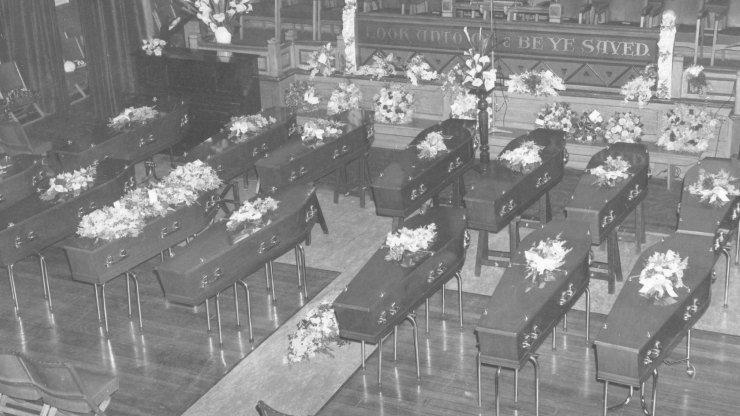
In 1966 it would become the site of Australia's worst ever fire tragedy, when 30 people perished in a blaze started by a resident knocking over an illegal heater after the Army delayed in calling the fire brigade, believing they could handle the conflagration themselves (I suppose if you're on a divine mission ...). 

The 15 unclaimed coffins from the William Booth Memorial Home Fire, 1966
Source: Kim Raineby Snr via The Age

The building housed mostly alcoholics at the time of the fire, many elderly. Nobody came forward to claim 15 of the 30 bodies. 

A plaque was placed by the Metropolitan Fire Brigades at the rear of the Commonwealth Law Courts in 2015 to commemorate the 50 year anniversary of this largely forgoten event. 


Geoff Plunkett, who authored a book on the fire "Let the Bums Burn" notes that Australia's worst ever fire tragedy isn't even mentioned in The Australian Book of Disasters (Larry Writer, Murdoch Books, 2011). 

It's a question, as always, of which lives matter to us. It's surely no accident that it was the fireys whose members actually experienced the trauma first-hand who wound up laying the plaque.

Aerial View of the William Booth Memorial Home in 1938
Source: State Library of Victoria

The building actually survived the fire, but was absurdly demolished in the 1990s for the Commonwealth Law Courts development, where a sheer blank wall now exists facing the streetscape instead of incorporating what was a readily repurposable structure of significant aesthetic qualities and with an important embedded social history. 

Again, it's a question of who and what matters. 

The Lt Lonsdale St site today - Google Street View

Thankfully no such tragedies, by fire or by wrecking ball occurred at the A'Beckett St home.


The Salvation Army Gill Memorial Home for Men 1928-c.2000

The converted Moss White factory building housed over 300 men in four large dormitories of 69 beds each at the time of opening (plus a smaller one of 25 beds reserved largely for the very elderly) across its six floors, with prices similarly stratified. Prices at opening ranged from fouprence through to a shilling a night, depending on the location.


Beds on the most desirable first floor (it seems residents were debarred use of the elevator) went to the "toffs" who by 1948 were paying an exorbitant rate of up to 1/9 (one shilling and ninepence) per night, where the standard nightly rate had by then risen to 1 shilling.


The Gill Memorial Home, A'Beckett St frontage, early 1980s
Source: Graeme Butler


In the same year, a three course meal would set a man back a shilling, while two courses could be secured for merely ninepence.


As with the William Booth, the establishment was run as a not-for-profit venture, and the Salvation Army reported an operational loss of around 18 pounds ten shillings a week associated with the institution in 1932.


A sixth dormitory was reserved for the home's staff, who numbered 22 at the time of its opening.


The policy was always to refuse nobody shelter, provided there was room to supply it, and consideration was always given to men who could not pay, provided they had some prospect of doing so shortly.


Hopeful entrants would line up each night at a window in Wills Street "which resembles a theatre box office", and attendants were stationed by the dormitories on each floor of the building to collect tickets (described in one report as "lodging discs").


"Mulga" Bill, described by The Argus as "a well-known and kindly old client" queues at the ticket window of the Gill Memorial Home in 1948
Source: The Argus


Many of the residents actually held regular employment, including large numbers at the nearby Victoria Market - whose proximity was a significant factor in the Army's choice of location for the venture. It was these regulars with some means of self-support who largely comprised the "toff" segment.


Tradesmen, laborers, wrestlers, boxers and even a singer were reportedly amongst the insitution's denizens in 1930, when beds could be secured on the less desirable levels of the building for a mere threepence.


The home had opened just in time for the Great Depression to hit, when demand for the organisation's services was routinely strained by people who had erstwhile been ordinary contributing members of society looking for either accomodation or an affordable feed.


By 1932, the home was reportedly serving over 5,000 meals per week "at prices ranging from one penny to sixpence". That's a figure in excess of 700 meals a day - a figure that would swamp most restauranteurs.


The Gill was thus arguably the most important culinary establishment in all of Melbourne as the city approached it's hundredth year of existence, although its menu awash with mince meat, stew, sausages, bread and cocoa would have done little to inspire most gastronomes.


Mealtime at The Gill Home, c.1967
Source: State Library of Victoria


In the same year, the "user-pays" regime somewhat came apart as the State Government began paying the Army 5 shillings a week to house recipients of its "Susso" sustenance payment - welfare instituted in the Great Depression and reserved exclusively for the long term unemployed who had no assets of their own.


In 1932, fully 270 of the building's incumbents were reportedly on the Victorian government "susso" payment.


Queues forming at the Gill Home as recently as 1995
Photographer: Mathias Heng - Source: State Library of Victoria


In 1930, the same paper reported that between 50 and 100 men were regularly being turned away from the home every night. In 1937 the home elected to make 50 beds a night completely free of charge in a bid to ease the city's homelessness crisis.


Winters were said to be the busiest times for demand, although major events such as the Melbourne Cup would also see an influx of visitors from country towns and interstate which would equally strain the facility.


The depression of course eventually subsided, but still The Argus reported in 1948 that the building was "always full", and the "house full" signage was routinely displayed by 11pm on most evenings, although 6pm was considered "peak hour" for most "bookings".


The links between homelessness and substance abuse are of course long established and inevitable. The head of the organisation, Brigadier Herbert Sheldrick, advised the paper that "drunks cannot be barred, because 90% of our clients arrive every night in some stage of inebriation".


The house rules at "The Gill" c.1967
Source: State Library of Victoria 


Alcohol itself was strictly prohibited on the premesis, although the tenants reputedly made every creative attempt imaginable to circumvent the regulation.


Behavioural issues were thus something of a given at the institution, and a record was kept in a big black book of resident misdemeanours, with many being permanently debarred from the place for their infractions. A police patrol payed a routine nightly visit to the home. The top floor of the building was reserved for "casuals and difficult customers".


Brigadier Herbert Sheldrick, a one-time butcher from country NSW, toils away in the kitchen of the Gill Memorial Home in 1948
Source: The Argus

Every effort was made to include facilities for the edification of the residents. The ground floor of the newly refurbished building boasted a reading room, a washroom and a smoking room equipped with a fireplace. Voluntary "Divine Services" were held from 6pm on Tuedays and Sundays, accompanied by a good old Salvation Army brass band comprising members of the Home's staff.


Cleanliness was strongly emphasised as a virtue at the home, and the building was refitted with its own state-of-the-art laundry, daily churning out crisp white bed linen for its denizens, which was changed weekly. The dormitories were cleared of all occupants by 7.45 each morning, and a check of all bed linen for unwanted pests was made. The price of bringing such vagrants into the building was a mandatory bath and fumigation of all belongings.


Those who arrived in a less than desirable state of sanitation were issued with a "blue ticket", which meant they needed to pass through a special showering facility and, as their clothing required fumigation, they were then sent off to bed completely unrobed to sleep "raw". The practice of issuing such men with nightgowns had to be discontinued owing to a tendency for the gowns to disappear, concealed beneath the men's clothing the following day.


Queues form of homeless men for the Gill Memorial home outside the former 1884 telephone exhchange (Melbourne's first) on the opposite (west) side of Wills St c.1966
Source: State Library of Victoria

The same location today - a sterling example of how NOT to do facade retention, and further evidence that the planners at City of Melbourne have well and truly drunk the developers' Kool Aid
(Google Street View)


We are indebted to photographer Mathias Heng who has provided history with probably the last lot of documentary evedence of the Gill Home, through a set of photographs taken in 1995 - just a few years before its eventual closure.


Time and property prices eventually mitigated against the accomodation model employed at the Gill Home. The practice of housing large numbers of vulnerable people - many with long term mental health issues in large dormitory style accomodation fell out of favour in the welfare sector.


The Gill was closed in the late 1990s in favour of newer accomodation forms that housed people in single bed rooms, although that model of course required a much larger floorspace to accomodate the same number of people.


Dormitory at the Gill Home with dutiful penitent, seen in 1995
Photographer: Mathias Heng - Source: State Library of Victoria

The Age in 2002 quoted The Salvation Army's then general manager of adult services, Jane Barnes as stating "disgusting and archaic night shelters are a thing of the past". But highlighting the difficulty in replacing the scale of accomodation they could supply, continues;

"The old Gill Memorial Home for Men ... which housed 200 people a night in dormitories containing 50 beds, has been replaced with the Flagstaff, which comprises 64 beds in separate rooms, and the Open Door in North Melbourne, with 44 separate rooms."

Some of the fabulous hair sported by residents at the Gill Home, seen in 1995
Photographer: Mathias Heng - Source: State Library of Victoria


"The Gill" Apartments

In another dramatic change of purpose for this highly storied building (storeys of stories, no less), the former Moss, White & co factory was subdivided and converted to 20 luxury apartments by architects Nation Fender Katsalidis in 2000. The redevelopment added a communal gym, spa and heated pool to the complex.


The benefits of residential densification to central Melbourne are of course real, but they are perhaps not universal - when you consider an institution once capable of catering nightly to over 300 of society's most needy (200 by some estimates at the time of its closure) is now home to no more than three dozen of the almost definitionally wealthiest.


A'Beckett St frontage of "The Gill" Apartments c.2020
Source: City of Melbourne

As conversions go, it must be said that the developers have been faithful to the building exterior, excepting that the distinctive white paint applied to the stoccoed areas seems historically inaccurate. 1980s photos indicate the scheme was more of a cream-yellow hue by that time, but the building would certainly have been repainted over the course of 100 years, and it's impossible to know how the 1880s scheme would originally have appeared purely from black and white photos.


The retention of the original six storey building plan behind the retained facade is a welcome degree of compliance with sound heritage practice - and a practice that all too regularly goes unenforced on other sites (hello, Emporium).
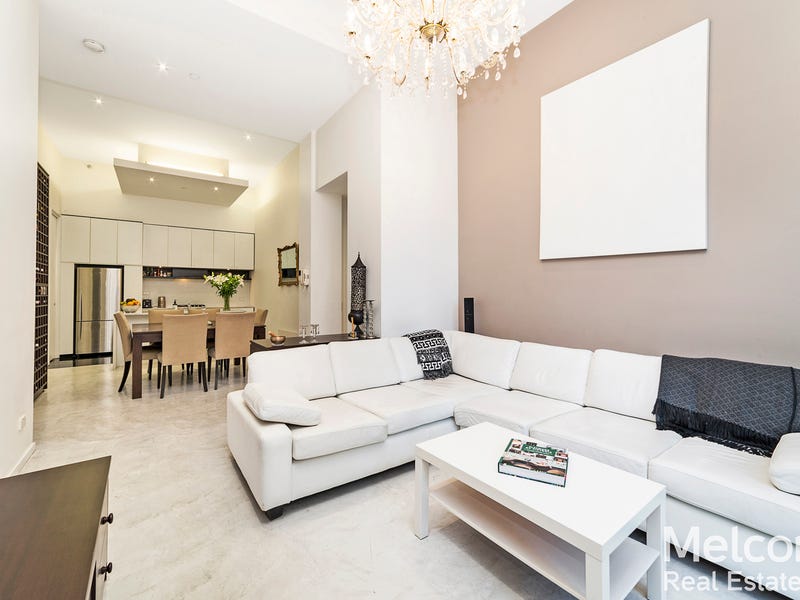

The "sleek interior" of apartment 302 at "The Gill" Apartments in 2017
Source: Melcom Real Estate


The sales spiel for apartment 302 waxed ebullient in 2017;

"Originally built in 1888 by Nahum Barnet as a tabacco (sic) factory ... the sleek interiors feature a spacious lounge and dining, boasting ceiling heights up to 13 feet and large original timber windows (EDITOR'S NOTE: The windows are NOT original to the factory) with a sophisticated kitchen appointed with stone benches, glass splashbacks and European stainless steel appliances, master bedroom with walk in robe and ensuite, second bedroom BIRs and sparkling central bathroom.

The three bedroom apartment 501 at "The Gill" sold in 2015 for $1.52m, which is a lot of shillings per night, even if you live to be the next Methusalah.


But at least the building is still there, facade wholly intact and without a giant new tower sticking out of the top of it, and barring no further intervention by flames nor similar acts of "God", should still be there as a prominent remnant of the city's 19th into 20th century working class and industrial heritage in another 140 odd years.


Thanks for staying with me this far, readers.
If you're into this sort of content, we'll be ramping up this blog in a big way in 2023.
Make sure you don't miss out on future posts from the Wombat - stay in touch on social media via one of the million or so links in the sidebars ...


REFERENCES

'Central Activities District Conservation Study' - Graeme Butler, 1984

'Messrs Moss White & Co's New Premesis', The Age, 26 October 1889

'The A'Beckett Street Fire', The Argus, 9 February, 1898

'Messrs Moss White & Co.", The Weekly Times, 14 December, 1889


Monday, 2 January 2023

The VFL & Global Development of the Curvilinear Grandstand - a Melbourne History with a Tragic Ending

Condemned - the Jack Dyer Stand at Punt Road Oval
Source: Graeme Butler

As readers may be aware, Heritage Network - Victoria's nomination of the Jack Dyer Stand at Punt Rd Oval to the State Heritage Register has recently been declined by the Executive Director of Heritage Victoria, on the basis that it is assessed as being of local-level significance, rather than of significance to the entire State of Victoria.


Introduction

Today's blog will form part of a series which will look at various aspects of the stand's significance and history. 

Readers interested in having input into the final determination by the Heritage Council on Heritage Victoria's recommendation will find information on how they can do so at the conclusion of this article.

Current and future posts in this series:

The History of Punt Road Oval and the Jack Dyer Stand
Victoria's Oldest Sporting Grandstands
A Potted History of Yarra Park 
The History of the MCG and its Grandstands
Melbourne City Council - Casting Aside Heritage for Self-Interest 


Heritage Victoria Bequeathes World Sporting Heritage to the Scrapheap

Naturally enough, I disagree strongly with the Director's assessment - an assessment which rests on a specific rejection of those unique and important contextual aspects of the State's cultural and historic development to which the stand not merely speaks, but remains the most significant remnant structure in Victoria capable of so doing. 

The Executive Director asserts that "The Jack Dyer Stand at Punt Road Oval is of a class of ‘grandstand’. The guidelines state that a class should be readily discernible as a sub-category of a broad place type and should not be narrowed by multiple qualifiers."

HNV's extensively worded submission made the case that in fact the class of building that the Jack Dyer Stand represents is "curvilinear grandstand" - of which it is the second-oldest, largest and most elaborate remnant example in the state.

The Jack Dyer Stand at Punt Rd Oval, as originally constructed in 1914, seen here c.1920, prior to its 1921 extension, with a new western bay added in matching style to a design by architect, town planner and former Melbourne Lord Mayor, Frank Stapley.
Source: Hansen, B. (1989). Tigerland: The history of the Richmond Football Club from 1885. Richmond Former Players and Officials Association.

The Director's assessment seems somewhat disingenous in that the regulations specifically mitigate against MULTIPLE qualifiers, however HNV's submission that the typology of the building is "curvilinear grandtsand" can readily be discerned as containing only ONE qualifier, and so definitionally within the guidelines.

HNV's submission goes to great lengths to demonstrate the unique role that Victorian venues associated with the spectacular growth in popularity of the VFL in the early years of the 20th century played in the GLOBAL development of the curvilinear grandstand form, presaging the later development of the modern "stadium" form, and of the significance of that early period of growth in the game to the entire state of Victoria's history and sense of state identity.

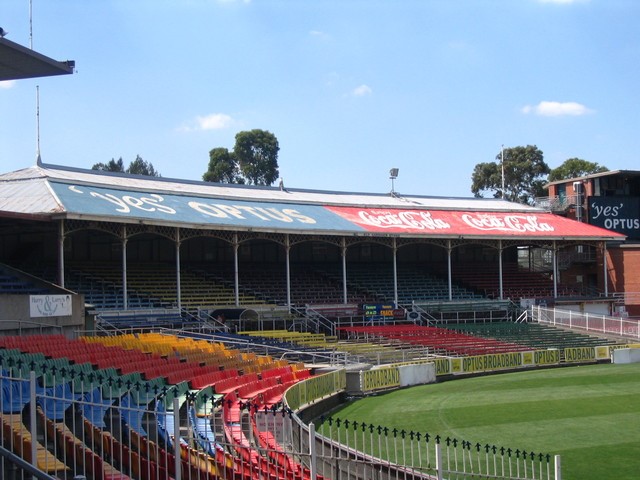
Looking westerly across Punt Road Oval to the Jack Dyer stand today.
Source: Author's own image

By disregarding these arguments and leaving the stand with only local-level protections in place - Heritage Victoria have thereby condemned the building to its already approved demolition, and the state of Victoria will be left bereft of any possible future appreciation in built form of this significant phase in Victoria's cultural and social history.

I outlined recently The Case for Preserving The Jack Dyer Stand, and future posts here will examine some of those points in more detail, but today I want to focus on documenting for posterity the stand's significance to all Victorians and to the wider sporting world, even as the built fabric is now almost inevitably lost to us.

Detail of the western end of the Jack Dyer Stand as viewed today from Yarra Park.
Source: Author's own image.


The Importance of the Curvilinear Grandstand

Cricket is unique amongst the world's major spectator sports for being played on a large, oval-shaped field, and Melbourne is unique amonsgt those cities of the former British Empire where cricket became the main summer sporting passtime for developing a sporting code in Australian Rules Football to occupy those playing fields in the winter months.

A record 46,000 spectators pack Punt Road Oval to watch Richmond’s 15 point loss to Carlton in Round 9, 1946
Source: The Holy Boot's Football Emporium

It is a unique requirement for development at cricket/football ovals, as opposed to racecourses, showgrounds, athletics tracks, velodromes or rugby/soccer pitches that constructing grandstands beyond a certain scale to the traditional rectilinear form necessarily places some spectators at a greater distance from the action on the field than others - the ovoid form of the required playing field ensures this is a physical or geometric reality. 

The Victorian Football League underwent a spectacular period of growth in spectator demand following the establishment of the semi-professional competition in 1897, which created significant pressure for the development of expanded spectator facilities at grounds which hosted VFL matches - pressure which was not present in Sydney, Brisbane, nor any other of the world's major cricketing cities.

Looking west over Lakeside Oval, South Melbourne during a VFL game, with the ground's early curvilinear grandstand (destroyed by fire in 1963) on right, c.1930
Source: State Library of Victoria

Consequently, the already discussed geometric imperatives ensured that the larger grandstands that arose at these sites in the early years of the 20th century began to take on a curvilinear form as spectator numbers grew.

Prior to the widescale commercial adoption of reinforced conscrete construction methods in the early 20th century, multi-tiered grandstands were a rarity not merely in Melbourne, but worldwide. So the requirement for larger stands in the Victorian and early Edwardian eras generally meant building outwards around the perimeter of the field, rather than upwards.

The earliest major curvilinear grandstand built in Victoria was the 1885 Northern Grandstand constructed at the Melbourne Cricket Ground after the ground's first major "reversible grandstand" was destroyed by fire. 

The destroyed stand's seating was reversible through an innovative rope pulley system to allow it to be used by spectators of the early Australian Rules Football games played in Yarra Park (or the "Richmond Paddock" as the informal football field was known).

Looking NE over MCG from Government House tower, early 1870s, with original wooden Members Pavilion on left. The "reversible" grandstand would be built to its right in 1876.
To the NE of the ground (ie top mid-image) is the area colloquially known as the “Richmond Paddock”, where the first games of Australian Rules Football were played.
Source: State Library of NSW, Call No: ON 4 Box 70 No 42a

This provision became unnecessary as the rough and tumble new football code - initially seen as unsuitable for the immaculately manicured turf of gentlemen's cricketing ovals - came quickly to be regarded as an effective means of utilising the expansive ovals during the winter months, and the coin that came with those attendant crowds proved a strong allure to administrators of those places, enabling development of spectator stands at the more popular venues that would otherwise have seemed financially dubious.

Thus, by 1885 there was no longer any need to rebuild a "reversible" grandstand at the MCG, as the Australian Rules games had moved from the "paddock" behind to front and centre onto the main playing surface.

Looking easterly from the 1906 Grey Smith Stand at the Melbourne Cricket Ground, past the second Members Pavilion to the Northern Grandstand in 1912. 

The new grandstand was built in two phases, a single-tiered expanse in 1885 with new double-storey tiered bays being added to its extremities (as seen above) in 1897, almost doubling the stand's capacity to around 10,000 spectators.

While my research is admittedly not exhaustive, it seems that this was in fact the first curvilinear grandstand constructed at anything like its scale anywhere on earth.

As we will see shortly, Yarra Park and the MCG in particular became the late 19th and early 20th century cradle for the global development of the freestanding curvilinear grandstand and later the large-scale contiguous stadium, many decades ahead of similar developments in comparable places worldwide.

The Jack Dyer Stand is today the last remaining structure in Yarra Park connected to that period of innovation, and its loss will be to the detriment of the entire planet's sporting heritage.


Pre-WWII Curvilinear Grandstands Constructed in Victoria

The following table lists the major curvilinear grandstands constructed in Victoria prior to WWII, at which time Melbourne was the unquestionable global capital of the curvilinear grandstand form.

Note, all but one of the listed structures (Yarra Park's Motordrome garndstand) were built at VFL-associated venues, and in fact the basin of the motodrome was itself used as a football field, with the venue hosting matches in the amateur VFA competition at various stages, including the VFA finals series from 1925-7 and even some VFL regular season games while the MCG was being resurfaced in 1932.

Melbourne Motordrome, looking west towards grandstand, with Olympic Park Oval at rear, 1945.
Source: State Library of Victoria

In fact, the Richmond Football Club came within a single vote of moving its home games from Punt Road Oval to the Motordrome in 1936.

So, in actuality the entire pre-WWII development of the curvilinear grandstand in Victoria was in some way associated with the VFL competition.

Note also in the following table, the rapid proliferation of the form (unparalleled anywhere else on earth) in the early years of the 20th century - directly associated with the spectacular growth in popularity of the VFL competition in its formative decades.

Name

Location

Built

Demolished

Style

Material

Northern Grandstand

MCG

1885

1955

Victorian

Brick

Grandstand

Sth Melbourne Cricket Ground/Lakeside Oval

1903

1963

Edwardian

Wood

Grandstand

Nth Melbourne Recreation Reserve/Cricket Ground/Arden St

1906

1970s

Edwardian

Wood

Grey Smith Stand

MCG

1906

1966

Transitional Edwardian

Brick

Harrison Stand

MCG

1908

1936

Edwardian

Wood

Ald. Gardiner Stand

Princes Park

1909

Extant

Edwardian

Brick

Wardill Stand

MCG

1911

1936

Edwardian

Brick

Jack Dyer Stand

Punt Road Oval

1914

Extant

Edwardian

Brick

Dick Reynolds Stand

“Windy Hill”, Essendon

1925

Extant

Edwardian-Modernist

Brick

Jack Ryder Stand

Victoria Park

1929

Extant

Edwardian-Modernist

Brick

Motordrome Grandstand

Yarra Park

1932

c.1950

Edwardian

Brick

Robert Heatley Stand

Princes Park

1932

2008

Edwardian

Brick

Southern Stand

MCG

1937

1991

Industrial

Concrete

Michael Tuck Stand

Glenferrie Oval

1938

Extant

Modernist

Brick

Note also, the only stands on that list which are not lost to us today are the Gardiner Stand at Princes Park, the Jack Dyer Stand, the Dick Reynolds Stand (which has been modified from the original beyond all recognition), the Jack Ryder and Michael Tuck Stands.

Plainer & much smaller than the Jack Dyer Stand - the Alderman Gardiner Stand, Princess Park, Carlton, as seen in 2008
Source: Picture Victoria

In addition to being smaller and significantly less elaborate than the Jack Dyer Stand, Princess Park's Gardiner Stand makes no contribution to the heritage values of a place already recognised as being of state significance (Yarra Park - with the Jack Dyer Stand being visible from over 20% of the entire protected area), with major view lines existing to the Jack Dyer from other significant locations- most  notably the southern and eastern suburbs railway lines and Punt Road.

Appreciation of the Gardiner Stand in its historic context is also severely hampered by the addition of other much larger modern grandstands abutting it on either side. 

It should of course be noted that the Carlton Football Club easily managed what Brendan Gale's Richmond was incapable of - retaining a built form linkage to the club's proud heritage in the Gardiner Stand while redeveloping the site as a modern training and playing facility.

How much competitive advantage will Carlton players at training gain by being able to look up and be inspired by a hard, physical reminder of the hundred plus years of club heritage - the proud lineage of former heroes which they continue themselves, having being chosen to don the guernsey?

Richmond take on Collingwood at Punt Road Oval in the 1927 VFL finals series, as crowds watch on from a packed Jack Dyer Stand.
Source: Richmond FC - The Tigers, Trevor Ruddell, Slattery Media Group, 2012, p.47 (image from Richmond FC Museum)

Whatever your answer to the above question, the Richmond Football Club will have thrown away more than the same quantum by robbing its training place of a far more impressive and larger scale stand, before which the legendary Jack Dyer played and coached most of his games, and for whom the stand was later named.

Brendan Gale and Peggy O'Neil will be so plainly robbing their club of so much intangible worth through this project that it's clearly pointless making any entreaties to people who demonstrably haven't the depth of either perception or emotion to even comprehend them.

The moderne-styled Michael Tuck Stand at Glenferrie Oval, Hawthorn c.1956
Source: State Library of Victoria

Continuing with the other relevant remnant stands, the Michael Tuck Stand at Glenferrie Oval was constructed significantly later in a modernist, rather than edwardian style, and represents in essence a second phase of curvilinear grandstand development in the state. 

The Dick Reynolds Stand today retains almost nothing of its original form, and the Jack Ryder Stand at Victoria Park is atypically plain and unelaborated - being the product of depression-era austerity. 

In many senses it beggars belief that the Ryder Stand is considered of state-level heritage significance, while the Jack Dyer Stand is not - and to such an extent that it actually calls into question the criteria being employed by Heritage Victoria.

The Dick Reynolds Stand at Windy Hill, as originally constructed and packed with spectators at its grand opening match - Essendon vs Carlton, May 6, 1922 - a crowd of 21,000 was in attendance.
Source: Essendon FC
Only Princess Park's significantly smaller, less elaborate and slightly older Gardiner Stand presents as any sort of viable comparitor to the Jack Dyer Stand as a representative early exemplar in the development of the curvilinear form, but it is clearly and by any assessment the less significant of the two almost contemporaneous structures.


Yarra Park - The Cradle of Curvation


Of the seven curvilinear stands built before the Jack Dyer, four of these were also located within Yarra Park at the MCG. Of the fourteen stands identified, seven of those were built within the originally gazetted Yarra Park, and five of those at the southeast corner of the park as protected today.

The almost featureless industrial utility of the Jack Ryder Stand at Victoria Park (protected on the State Heritage Register for being of state-level significance while Heritage Victoria asserts the Jack Dyer Stand is only of local-level significance 🤪😳), as seen in 2003
Source: Victoria Park.net

In the period following the removal of the East Melbourne Cricket Ground in 1921 and up until construction of the first grandstand at Olympic Park in the 1950s, every one of the major stands situated within the originally gazetted Yarra/Flinders Park recreation area was of a curvilinear form, underlining the importance of the place to the form's emergence.

The Jack Dyer Stand is the only survivor among those original stands today (and has been so since the Grey Smith Stand was replaced by the Ponsford in 1966), yet now we are prepared to wipe that sole remnant built form away, even while Yarra Park is supposedly a protected place on the Victorian Heritage Register (VHR).

It begs the question in the context of Heritage Victoria's determination; what exactly is the point of Yarra Park's registration on the VHR, excised of all the recreational spaces that are effectively actually part of it, just sitting there protecting little more than a bunch of trees, to which the registration is of course incapable of granting immortality?


Melbourne - Birthplace of the Curvilinear Grandstand

The rapid rise in Victoria’s population owing to the gold rushes that began in the 1850s, and sustained long after the gold ceased rushing by the associated speculative “land boom”, dovetailed perfectly with the rise in popularity of team-based sports such as cricket, rugby and soccer throughout the British Empire and its former colonies.

The Grey Smith Grandstand at the MCG, seen at its opening in 1906.
Ever since the stand's 1966 demolition, the Jack Dyer Stand has been the sole remnant in Yarra Park of the freestanding curvilinear grandstands for which the place is so notable in giving rise to.
Source: Blueseum

Yet Victoria was the first place anywhere on earth where a new football game was codified, and alone of anywhere on earth for codifying a sport that enabled the utilisation of a cricket oval during winter months.

The resultant demand for increased spectator capacity at cricket grounds was thus a uniquely Victorian phenomenon - where the greenfields nature of the new settlement, surrounded by vast tracts of land free of permanent existing structures (if not peoples), enabled the construction of grounds that were truly oval in geometry, which combined with the laws of physics to ensure that the state’s capital city became the premier city anywhere on earth for the emergence and development of the curvilinear grandstand form.

Aerial view of the Melbourne Cricket Ground, with its freestanding curvilinear stands, c.1928 - namely the Northern Grandstand bottom left, Harrison Stand at top, Wardill stand top right, and Grey Smith stand adjacent to an under construction Members Stand, bottom right.
Source: Australian Sports Museum

Today the Melbourne Cricket Ground boasts the second largest spectator capacity of any cricket ground on earth behind India’s Narendra Modi Stadium, and is the 10th largest sportsground by capacity anywhere on earth.

As the table above highlights, on its way to attaining that status in the early years of the 20th century, the MCG was certainly the planet's major location for large scale curvilinear grandstands, boasting no fewer than four such structures built to a scale and degree of elaboration unparalleled at the time for any other cricket venue on earth.

Detail from ‘Aerial View of Melbourne Cricket Ground, Melbourne’, showing the new Southern Stand now the dominant feature at the ground, c.1950
Source: State Library of Victoria

The transformation of the ground from a series of isolated curvilinear stands into a contiguous "stadium" format occured in stages, arguably the most momentous of which was the 1937 construction of the Southern Stand, which presaged by many decades a similar pattern of development at today's largest cricketing arenas.

The global significance of Melbourne's early freestanding curvilinear VFL grandstands in the development of the modern stadium form, cannot therefore be overstated.


Global Comparisons

The next largest cricket ground after the MCG is the 68,000 capacity Eden Gardens Stadium in Kolkatta - which has itself hosted cricket matches since the 1860s, but where development to accomodate large numbers of spectators did not occur until well after WWII.

While the country dominates the lists of the world's highest capacity cricketing venues today, cricket in India was in the early years of the 20th century a game predominantly played and enjoyed by social elites. 

The game's growth in popularity as a mass spectator sport did not occur there until well in to the second half of the 20th century, and consequently the place did not contribute in a major way to the early development of the curvilinear grandstand. Most construction at Indian cricket grounds in the years prior to WWII was limited to small pavilions and rectilinear stands.

As the following images indicate, stands at the Sydney Cricket Ground, the only major cricket ground in an Australian city comparable to the MCG in spectator capacity were all rectilinear in form until well into the 20th century.

Stands at the Sydney Cricket Ground in 1911, with 1909 Sheridan pavilion at centre and 1880s Brewongle Stand to its right.
Source: Google Arts & Culture

“Reverse Angle” of stands at the Sydney Cricket Ground in 1903, with Brewongle Stand on left, then (L-R) Members pavilion, Lady Members pavilion, Northern Stand and Hill Stand, all built to rectilinear plans.
Source: Wikimedia Commons

The highest capacity cricket venue in New Zealand today is Auckland’s Eden Park, with room for just 48,000 spectators - making it the 17th largest on earth. All other cricket grounds ranked ahead of it for capacity are either in India, where cricket has become the highly populous country’s premier spectator sport by a significant margin, or Australia, where Australian Rules football is played during the winter months at all of the subject grounds.

Stands at The Oval (a geometric misnomer if ever there was one), London in 1950 show a mostly rectilinear form at one end of the ground, with the remainder of the playing field surrounded by uncovered single tier embankments and a small and wholly unstyled grandstand being the only architectural feature at the other end of the ground. When the first Australian national touring side played here in 1880, the MCG was already set to overtake the ground for both architectural significance and spectator capacity
Source: Google Arts & Culture

Many of the playing fields at the main cricket “ovals” in metropolitan areas in the UK are in fact not geometrically ovoid in shape at all. A detailed comparative analysis is beyond the scope of this study, but this is largely a consequence of those grounds mostly being developed within existing and built-up residential areas as opposed to the bounteous expanses of land available for recreation in the country's newer colonies. 

These geographic and demographic realities, coupled with an absence of any utility for the places in the winter months mitigated heavily against British cricket grounds facing similar development pressure to that experienced at Melbourne's VFL-associated venues. 

Consequently the UK made no significant contributions to the development of the curvilinear grandstand form until the latter half of the 20th century, many decades after the Victorian VFL venues had begun pioneering it.

Playing field geometries at all venues used in the 2019 ICC Cricket World Cup in England/Wales. The only ground which is a true ovoid is the Rose Bowl ground, which was constructed as a greenfields venue in 1987
Source: Sports India Show

Thus the popularity of Australian Rules Football is clearly linked to the enhanced development pressure at cricketing venues that play host to its games, and which thus essentially see year-round utilisation. And the VFL competition's growth in popularity in the early years of the 20th century is clearly linked to the pioneering development of the curvilinear form at its associated venues, and was an important precursor in the emergence of the modern stadium form

Grandstands at Nth Melbourne Recreation Reserve/Arden Street with early curvilinear stand on right - seen here c.1950s. The stand was set back so far from the playing field to accomodate a greyhound track around the playing field at the time of its construction.
Source: State Library of Victoria

The globally pioneering development of the curvilinear grandstand in Victoria is therefore a direct consequence of those two uniquely significant patterns of development in the state’s history - the gold rushes, and the origin, development and growth of Australian rules football.


Conclusion

The Jack Dyer Stand at Punt Road Oval is by far the most significant and representative remnant of the form standing in the State of Victoria today, and is particularly significant as the only remaining representative comparator to the curvilinear form that was pioneered more than anywhere on earth in Yarra Park and in particular the ground's neighbouring Melbourne Cricket Ground.

With the exception of the long demolished Northern and Grey Smith Stands at the MCG, it is also the most architecturally significant such building ever constructed in Victoria. 

As the finest remaining exemplar of its typology and its period, its loss will leave Yarra Park, the Richmond Cricket and Football Clubs, Australian Rules Football, Punt Road Oval, the history of world sport, and indeed the entire State of Victoria so greatly denuded, that it is hard to conclude with any other assessment than that Heritage Victoria has failed tremendously in its duty to posterity, and that the systems of assessment which the body employs are too arbitrary by half in their application.

Architect's render of the uninspired, unremarkable, insipid, ahistorical and anti-spectator substitute Jack Dyer Stand, for which Brendan Gale's Richmond Football Club will now void their own history and foist upon future Melbourne for absolutely no good reason.
Source: Richmond Football Club Redevelopment, Cox Architecture, 2022


How You Can Help

The Executive Director of Heritage Victoria provides recommendations to the Heritage Council, which is a separate body that will make the final adjudication. 

It would be fairly unusual, but not unprecedented for the Heritage Council to make a finding contrary to the Director's recommendation, but as this is our final opportunity to save the Jack Dyer Stand, we are encouraging everyone with an interest to make a submission to the process.

The biggest obstacle for many may be that doing so requires the creation of an account at the Heritage Council's Heritage Hub, but it really is a simple process, akin to creating a new account on any website.

To have your say, just follow these simple steps
PLEASE NOTE SUBMISSIONS ARE DUE BY SUNDAY JANUARY 29, 2023

STEP 1 (Recommended) - Download Executive Director's Recommendation (PDF)
This step is obviously recommended as this is the document which the Heritage Council will either uphold or reject. The Council is unlikely to consider arguments that do not pertain directly to the document. Talking about your own perception of the place's heritage value is important, but those points should ideally be expressed in terms of "I believe the Executive Director is in error in determining the place is only of local level significance because ..." and then introducing your argument.

Download the Executive Director's Recommendation here:
https://heritagecouncil.vic.gov.au/registrations-reviews/executive-director-recommendations/
(see screenshot below to locate exact link)


STEP 2 - Create a Short Word Document (or PDF) of Your Objections
For many this will be the trickiest bit of the application - I don't want to waste too many words here, nor put words in anyone's mouth, but I would be very happy to assist anyone out there in forming their submission. If you're interested please CLICK HERE to send us an email.

I am working on a separate post which will dot-point some of the key bases for objections, and once that is complete will also link that here.

STEP 3 - Create HCV Hub Account
Either use the following link, or click the red "HCV Hub" button shown top right in the screen shot above

You should then see a window as follows. Click the "Sign Up" link at the bottom as shown, not the "Sign In" button, to create a new account (or simply add your login details if you already have an account).


Then simply supply your email, first and last names and a secure password as shown below and click "Sign Up". You will then be sent a link to confirm the validity of your email to the address you supplied.


STEP 4 - Login
After confirming your email, you should then be able to login per the following login screen with your HCV Hub credentials.
You can login at any future time again via

STEP 5 - Form A Submission
Once logged in, you should see a screen as shown below. Choose the top left option - "Form A Submission"

You will then see a screen as shown below. Feel free to read the content in depth, but it's all just administrative palaver, and you can feel safe in simply clicking the red "Next" button bottom left.


At the next screen, you need to make sure you've selected the checkbox relating to Punt Road Oval (see screenshot below - at the time of writing it appears at the top of the list of recommendations), then click the red "Next" button again, bottom right.


At the next screen, you need simply to fill out your contact details (then click "Next" bottom right)


And the following screen gives you the option of submitting on behalf of one other person. Most people will leave this box unchecked and simply click "Next" again.


At the next screen as seen below - be sure you first select the SECOND option: "Objects to the Executive Director's Recommendation"


Then state a brief summary of your objection in the field shown at 2 above, and attach your full objection document at 3, before clicking the "Next" button.

You should then be able to naviagte quickly through the final couple of screens and should receive an email confirmation of your submission.

If anyone gets into any trouble and needs assictance, either CLICK HERE to email me directly, or for technical support in using and accessing the HCV Hub, including creating a log in, please contact Planning Support on 1800 789 386 (select option 1) or email [email protected]

Again, for anyone who needs any actual help writing a submission, please contact me via the email above, otherwise, we'll be dot pointing a pro forma response for interested readers and pasting a link to it here shortly.

Thanks hugely to anyone who is able to help out.

Curvilinear love and mung beans,
Adam.