|
| Condemned - the Jack Dyer Stand at Punt Road Oval Source: Graeme Butler |
As readers may be aware, Heritage Network - Victoria's nomination of the Jack Dyer Stand at Punt Rd Oval to the State Heritage Register has recently been declined by the Executive Director of Heritage Victoria, on the basis that it is assessed as being of local-level significance, rather than of significance to the entire State of Victoria.
Introduction
Today's blog will form part of a series which will look at various aspects of the stand's significance and history.
Readers interested in having input into the final determination by the Heritage Council on Heritage Victoria's recommendation will find information on how they can do so at the conclusion of this article.
Current and future posts in this series:
The History of Punt Road Oval and the Jack Dyer Stand
Victoria's Oldest Sporting Grandstands
A Potted History of Yarra Park
The History of the MCG and its Grandstands
Melbourne City Council - Casting Aside Heritage for Self-Interest
Heritage Victoria Bequeathes World Sporting Heritage to the Scrapheap
Naturally enough, I disagree strongly with the Director's assessment - an assessment which rests on a specific rejection of those unique and important contextual aspects of the State's cultural and historic development to which the stand not merely speaks, but remains the most significant remnant structure in Victoria capable of so doing.
The Executive Director asserts that "The Jack Dyer Stand at Punt Road Oval is of a class of ‘grandstand’. The guidelines state that a class should be readily discernible as a sub-category of a broad place type and should not be narrowed by multiple qualifiers."
HNV's extensively worded submission made the case that in fact the class of building that the Jack Dyer Stand represents is "curvilinear grandstand" - of which it is the second-oldest, largest and most elaborate remnant example in the state.
.png) |
| The Jack Dyer Stand at Punt Rd Oval, as originally constructed in 1914, seen here c.1920, prior to its 1921 extension, with a new western bay added in matching style to a design by architect, town planner and former Melbourne Lord Mayor, Frank Stapley. Source: Hansen, B. (1989). Tigerland: The history of the Richmond Football Club from 1885. Richmond Former Players and Officials Association. |
The Director's assessment seems somewhat disingenous in that the regulations specifically mitigate against MULTIPLE qualifiers, however HNV's submission that the typology of the building is "curvilinear grandtsand" can readily be discerned as containing only ONE qualifier, and so definitionally within the guidelines.
HNV's submission goes to great lengths to demonstrate the unique role that Victorian venues associated with the spectacular growth in popularity of the VFL in the early years of the 20th century played in the GLOBAL development of the curvilinear grandstand form, presaging the later development of the modern "stadium" form, and of the significance of that early period of growth in the game to the entire state of Victoria's history and sense of state identity.
 |
| Looking westerly across Punt Road Oval to the Jack Dyer stand today. Source: Author's own image |
By disregarding these arguments and leaving the stand with only local-level protections in place - Heritage Victoria have thereby condemned the building to its already approved demolition, and the state of Victoria will be left bereft of any possible future appreciation in built form of this significant phase in Victoria's cultural and social history.
I outlined recently The Case for Preserving The Jack Dyer Stand, and future posts here will examine some of those points in more detail, but today I want to focus on documenting for posterity the stand's significance to all Victorians and to the wider sporting world, even as the built fabric is now almost inevitably lost to us.
 |
| Detail of the western end of the Jack Dyer Stand as viewed today from Yarra Park. Source: Author's own image. |
The Importance of the Curvilinear Grandstand
Cricket is unique amongst the world's major spectator sports for being played on a large, oval-shaped field, and Melbourne is unique amonsgt those cities of the former British Empire where cricket became the main summer sporting passtime for developing a sporting code in Australian Rules Football to occupy those playing fields in the winter months.
 |
| A record 46,000 spectators pack Punt Road Oval to watch Richmond’s 15 point loss to Carlton in Round 9, 1946 Source: The Holy Boot's Football Emporium |
It is a unique requirement for development at cricket/football ovals, as opposed to racecourses, showgrounds, athletics tracks, velodromes or rugby/soccer pitches that constructing grandstands beyond a certain scale to the traditional rectilinear form necessarily places some spectators at a greater distance from the action on the field than others - the ovoid form of the required playing field ensures this is a physical or geometric reality.
The Victorian Football League underwent a spectacular period of growth in spectator demand following the establishment of the semi-professional competition in 1897, which created significant pressure for the development of expanded spectator facilities at grounds which hosted VFL matches - pressure which was not present in Sydney, Brisbane, nor any other of the world's major cricketing cities.
 |
| Looking west over Lakeside Oval, South Melbourne during a VFL game, with the ground's early curvilinear grandstand (destroyed by fire in 1963) on right, c.1930 Source: State Library of Victoria |
Consequently, the already discussed geometric imperatives ensured that the larger grandstands that arose at these sites in the early years of the 20th century began to take on a curvilinear form as spectator numbers grew.
Prior to the widescale commercial adoption of reinforced conscrete construction methods in the early 20th century, multi-tiered grandstands were a rarity not merely in Melbourne, but worldwide. So the requirement for larger stands in the Victorian and early Edwardian eras generally meant building outwards around the perimeter of the field, rather than upwards.
The earliest major curvilinear grandstand built in Victoria was the 1885 Northern Grandstand constructed at the Melbourne Cricket Ground after the ground's first major "reversible grandstand" was destroyed by fire.
The destroyed stand's seating was reversible through an innovative rope pulley system to allow it to be used by spectators of the early Australian Rules Football games played in Yarra Park (or the "Richmond Paddock" as the informal football field was known).
 |
| Looking NE over MCG from Government House tower, early 1870s, with original wooden Members Pavilion on left. The "reversible" grandstand would be built to its right in 1876. To the NE of the ground (ie top mid-image) is the area colloquially known as the “Richmond Paddock”, where the first games of Australian Rules Football were played. Source: State Library of NSW, Call No: ON 4 Box 70 No 42a |
This provision became unnecessary as the rough and tumble new football code - initially seen as unsuitable for the immaculately manicured turf of gentlemen's cricketing ovals - came quickly to be regarded as an effective means of utilising the expansive ovals during the winter months, and the coin that came with those attendant crowds proved a strong allure to administrators of those places, enabling development of spectator stands at the more popular venues that would otherwise have seemed financially dubious.
Thus, by 1885 there was no longer any need to rebuild a "reversible" grandstand at the MCG, as the Australian Rules games had moved from the "paddock" behind to front and centre onto the main playing surface.
 |
| Looking easterly from the 1906 Grey Smith Stand at the Melbourne Cricket Ground, past the second Members Pavilion to the Northern Grandstand in 1912. |
The new grandstand was built in two phases, a single-tiered expanse in 1885 with new double-storey tiered bays being added to its extremities (as seen above) in 1897, almost doubling the stand's capacity to around 10,000 spectators.
While my research is admittedly not exhaustive, it seems that this was in fact the first curvilinear grandstand constructed at anything like its scale anywhere on earth.
As we will see shortly, Yarra Park and the MCG in particular became the late 19th and early 20th century cradle for the global development of the freestanding curvilinear grandstand and later the large-scale contiguous stadium, many decades ahead of similar developments in comparable places worldwide.
The Jack Dyer Stand is today the last remaining structure in Yarra Park connected to that period of innovation, and its loss will be to the detriment of the entire planet's sporting heritage.
Pre-WWII Curvilinear Grandstands Constructed in Victoria
The following table lists the major curvilinear grandstands constructed in Victoria prior to WWII, at which time Melbourne was the unquestionable global capital of the curvilinear grandstand form.
Note, all but one of the listed structures (Yarra Park's Motordrome garndstand) were built at VFL-associated venues, and in fact the basin of the motodrome was itself used as a football field, with the venue hosting matches in the amateur VFA competition at various stages, including the VFA finals series from 1925-7 and even some VFL regular season games while the MCG was being resurfaced in 1932.
 |
| Melbourne Motordrome, looking west towards
grandstand, with Olympic Park Oval at rear, 1945. Source: State Library of Victoria |
In fact, the Richmond Football Club came within a single vote of moving its home games from Punt Road Oval to the Motordrome in 1936.
So, in actuality the entire pre-WWII development of the curvilinear grandstand in Victoria was in some way associated with the VFL competition.
Note also in the following table, the rapid proliferation of the form (unparalleled anywhere else on earth) in the early years of the 20th century - directly associated with the spectacular growth in popularity of the VFL competition in its formative decades.
| Name |
Location |
Built |
Demolished |
Style |
Material |
Northern Grandstand |
MCG |
1885 |
1955 |
Victorian |
Brick |
Grandstand |
Sth Melbourne Cricket Ground/Lakeside
Oval |
1903 |
1963 |
Edwardian |
Wood |
Grandstand |
Nth Melbourne Recreation Reserve/Cricket
Ground/Arden St |
1906 |
1970s |
Edwardian |
Wood |
| Grey Smith Stand |
MCG |
1906 |
1966 |
Transitional Edwardian |
Brick |
Harrison Stand |
MCG |
1908 |
1936 |
Edwardian |
Wood |
Ald. Gardiner Stand |
Princes Park |
1909 |
Extant |
Edwardian |
Brick |
Wardill Stand |
MCG |
1911 |
1936 |
Edwardian |
Brick |
Jack Dyer Stand |
Punt Road Oval |
1914 |
Extant |
Edwardian |
Brick |
Dick Reynolds Stand |
“Windy Hill”, Essendon |
1925 |
Extant |
Edwardian-Modernist |
Brick |
Jack Ryder Stand |
Victoria Park |
1929 |
Extant |
Edwardian-Modernist |
Brick |
Motordrome Grandstand |
Yarra Park |
1932 |
c.1950 |
Edwardian |
Brick |
Robert Heatley Stand |
Princes Park |
1932 |
2008 |
Edwardian |
Brick |
Southern Stand |
MCG |
1937 |
1991 |
Industrial |
Concrete |
Michael Tuck Stand |
Glenferrie Oval |
1938 |
Extant |
Modernist |
Brick |
Note also, the only stands on that list which are not lost to us today are the Gardiner Stand at Princes Park, the Jack Dyer Stand, the Dick Reynolds Stand (which has been modified from the original beyond all recognition), the Jack Ryder and Michael Tuck Stands.
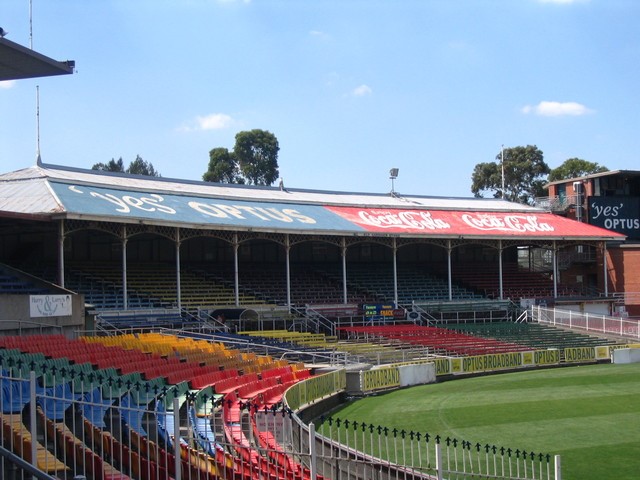 |
| Plainer & much smaller than the Jack Dyer Stand - the Alderman Gardiner Stand, Princess Park, Carlton, as
seen in 2008 Source: Picture Victoria |
In addition to being smaller and significantly less elaborate than the Jack Dyer Stand, Princess Park's Gardiner Stand makes no contribution to the heritage values of a place already recognised as being of state significance (Yarra Park - with the Jack Dyer Stand being visible from over 20% of the entire protected area), with major view lines existing to the Jack Dyer from other significant locations- most notably the southern and eastern suburbs railway lines and Punt Road.
Appreciation of the Gardiner Stand in its historic context is also severely hampered by the addition of other much larger modern grandstands abutting it on either side.
It should of course be noted that the Carlton Football Club easily managed what Brendan Gale's Richmond was incapable of - retaining a built form linkage to the club's proud heritage in the Gardiner Stand while redeveloping the site as a modern training and playing facility.
How much competitive advantage will Carlton players at training gain by being able to look up and be inspired by a hard, physical reminder of the hundred plus years of club heritage - the proud lineage of former heroes which they continue themselves, having being chosen to don the guernsey?
 |
| Richmond take on Collingwood at Punt Road Oval in the 1927 VFL finals series, as crowds watch on from a packed Jack Dyer Stand. Source: Richmond FC - The Tigers, Trevor Ruddell, Slattery Media Group, 2012, p.47 (image from Richmond FC Museum) |
Whatever your answer to the above question, the Richmond Football Club will have thrown away more than the same quantum by robbing its training place of a far more impressive and larger scale stand, before which the legendary Jack Dyer played and coached most of his games, and for whom the stand was later named.
Brendan Gale and Peggy O'Neil will be so plainly robbing their club of so much intangible worth through this project that it's clearly pointless making any entreaties to people who demonstrably haven't the depth of either perception or emotion to even comprehend them.
 |
| The moderne-styled Michael Tuck Stand at Glenferrie Oval, Hawthorn c.1956 Source: State Library of Victoria |
Continuing with the other relevant remnant stands, the Michael Tuck Stand at Glenferrie Oval was constructed significantly later in a modernist, rather than edwardian style, and represents in essence a second phase of curvilinear grandstand development in the state.
The Dick Reynolds Stand today retains almost nothing of its original form, and the Jack Ryder Stand at Victoria Park is atypically plain and unelaborated - being the product of depression-era austerity.
In many senses it beggars belief that the Ryder Stand is considered of state-level heritage significance, while the Jack Dyer Stand is not - and to such an extent that it actually calls into question the criteria being employed by Heritage Victoria.
 |
| The Dick Reynolds Stand at Windy Hill, as originally constructed and packed with spectators at
its grand opening match - Essendon vs Carlton, May 6, 1922 - a crowd of 21,000
was in attendance. Source: Essendon FC |
Yarra Park - The Cradle of Curvation
 |
| The almost featureless industrial utility of the Jack Ryder Stand at Victoria Park (protected on the State Heritage Register for being of state-level significance while Heritage Victoria asserts the Jack Dyer Stand is only of local-level significance 🤪😳), as seen in 2003 Source: Victoria Park.net |
In the period following the removal of the
East Melbourne Cricket Ground in 1921 and up until construction of the first grandstand
at Olympic Park in the 1950s, every one of the major stands situated within the
originally gazetted Yarra/Flinders Park recreation area was of a curvilinear
form, underlining the importance of the place to the form's emergence.
The Jack Dyer Stand is the only survivor among those original stands today (and has been so since the Grey Smith Stand was replaced by the Ponsford in 1966), yet now we are prepared to wipe that sole remnant built form away, even while Yarra Park is supposedly a protected place on the Victorian Heritage Register (VHR).
It begs the question in the context of Heritage Victoria's determination; what exactly is the point of Yarra Park's registration on the VHR, excised of all the recreational spaces that are effectively actually part of it, just sitting there protecting little more than a bunch of trees, to which the registration is of course incapable of granting immortality?
Melbourne - Birthplace of the Curvilinear Grandstand
The rapid rise in Victoria’s population owing to the gold rushes that began in the 1850s, and sustained long after the gold ceased rushing by the associated speculative “land boom”, dovetailed perfectly with the rise in popularity of team-based sports such as cricket, rugby and soccer throughout the British Empire and its former colonies.
 |
The Grey Smith Grandstand at the MCG, seen at its opening in 1906. Ever since the stand's 1966 demolition, the Jack Dyer Stand has been the sole remnant in Yarra Park of the freestanding curvilinear grandstands for which the place is so notable in giving rise to. Source: Blueseum |
Yet Victoria was the first place anywhere on earth where a new football game was codified, and alone of anywhere on earth for codifying a sport that enabled the utilisation of a cricket oval during winter months.
The resultant demand for increased spectator capacity at cricket grounds was thus a uniquely Victorian phenomenon - where the greenfields nature of the new settlement, surrounded by vast tracts of land free of permanent existing structures (if not peoples), enabled the construction of grounds that were truly oval in geometry, which combined with the laws of physics to ensure that the state’s capital city became the premier city anywhere on earth for the emergence and development of the curvilinear grandstand form.
 |
| Aerial view of the Melbourne Cricket Ground, with its freestanding curvilinear stands, c.1928 - namely the Northern Grandstand bottom left, Harrison Stand at top, Wardill stand top right, and Grey Smith stand adjacent to an under construction Members Stand, bottom right. Source: Australian Sports Museum |
Today the Melbourne Cricket Ground boasts the second largest spectator capacity of any cricket ground on earth behind India’s Narendra Modi Stadium, and is the 10th largest sportsground by capacity anywhere on earth.
As the table above highlights, on its way to attaining that status in the early years of the 20th century, the MCG was certainly the planet's major location for large scale curvilinear grandstands, boasting no fewer than four such structures built to a scale and degree of elaboration unparalleled at the time for any other cricket venue on earth.
 |
| Detail from ‘Aerial View of Melbourne Cricket Ground, Melbourne’, showing the new Southern Stand now the dominant feature at the ground, c.1950 Source: State Library of Victoria |
The transformation of the ground from a series of isolated curvilinear stands into a contiguous "stadium" format occured in stages, arguably the most momentous of which was the 1937 construction of the Southern Stand, which presaged by many decades a similar pattern of development at today's largest cricketing arenas.
The global significance of Melbourne's early freestanding curvilinear VFL grandstands in the development of the modern stadium form, cannot therefore be overstated.
Global Comparisons
The next largest cricket ground after the MCG is the 68,000 capacity Eden Gardens Stadium in Kolkatta - which has itself hosted cricket matches since the 1860s, but where development to accomodate large numbers of spectators did not occur until well after WWII.
While the country dominates the lists of the world's highest capacity cricketing venues today, cricket in India was in the early years of the 20th century a game predominantly played and enjoyed by social elites.
The game's growth in popularity as a mass spectator sport did not occur there until well in to the second half of the 20th century, and consequently the place did not contribute in a major way to the early development of the curvilinear grandstand. Most construction at Indian cricket grounds in the years prior to WWII was limited to small pavilions and rectilinear stands.
As the following images indicate, stands at the Sydney Cricket Ground, the only major cricket ground in an Australian city comparable to the MCG in spectator capacity were all rectilinear in form until well into the 20th century.
 |
| Stands at the Sydney Cricket Ground in 1911, with
1909 Sheridan pavilion at centre and 1880s Brewongle Stand to its right. Source: Google Arts & Culture |
 |
| “Reverse Angle” of stands at the Sydney Cricket Ground in 1903, with Brewongle Stand on left, then (L-R) Members pavilion, Lady Members pavilion, Northern Stand and Hill Stand, all built to rectilinear plans. Source: Wikimedia Commons |
The highest capacity cricket venue in New
Zealand today is Auckland’s Eden Park, with room for just 48,000 spectators - making
it the 17th largest on earth. All other cricket grounds ranked ahead of it for
capacity are either in India, where cricket has become the highly populous country’s premier spectator sport by a significant margin, or Australia,
where Australian Rules football is played during the winter months at all of the subject
grounds.
 |
| Stands at The Oval (a geometric misnomer if ever
there was one), London in 1950 show a mostly rectilinear form at one end of the
ground, with the remainder of the playing field surrounded by uncovered single
tier embankments and a small and wholly unstyled grandstand being the only
architectural feature at the other end of the ground. When the first Australian
national touring side played here in 1880, the MCG was already set to overtake
the ground for both architectural significance and spectator capacity Source: Google Arts & Culture |
Many of the playing fields at the main cricket “ovals” in metropolitan areas in the UK are in fact not geometrically ovoid in shape at all. A detailed comparative analysis is beyond the scope of this study, but this is largely a consequence of those grounds mostly being developed within existing and built-up residential areas as opposed to the bounteous expanses of land available for recreation in the country's newer colonies.
These geographic and demographic realities, coupled with an absence of any utility for the places in the winter months mitigated heavily against British cricket grounds facing similar development pressure to that experienced at Melbourne's VFL-associated venues.
Consequently the UK made no significant contributions to the development of the curvilinear grandstand form until the latter half of the 20th century, many decades after the Victorian VFL venues had begun pioneering it.
 |
| Playing field geometries at all venues used in the 2019 ICC Cricket World Cup in England/Wales. The only ground which is a true ovoid is the Rose Bowl ground, which was constructed as a greenfields venue in 1987 Source: Sports India Show |
Thus the popularity of Australian Rules Football is clearly linked to the enhanced development pressure at cricketing venues that play host to its games, and which thus essentially see year-round utilisation. And the VFL competition's growth in popularity in the early years of the 20th century is clearly linked to the pioneering development of the curvilinear form at its associated venues, and was an important precursor in the emergence of the modern stadium form
 |
Grandstands at Nth Melbourne Recreation Reserve/Arden Street with early curvilinear stand on right - seen here c.1950s. The stand was set back so far from the playing field to accomodate a greyhound track around the playing field at the time of its construction. Source: |
The globally pioneering development of the curvilinear grandstand in Victoria is therefore a direct consequence of those two uniquely significant patterns of development in the state’s history - the gold rushes, and the origin, development and growth of Australian rules football.
Conclusion
The Jack Dyer Stand at Punt Road Oval is by far the most significant and representative remnant of the form standing in the State of Victoria today, and is particularly significant as the only remaining representative comparator to the curvilinear form that was pioneered more than anywhere on earth in Yarra Park and in particular the ground's neighbouring Melbourne Cricket Ground.
With the exception of the long demolished Northern and Grey Smith Stands at the MCG, it is also the most architecturally significant such building ever constructed in Victoria.
As the finest remaining exemplar of its typology and its period, its loss will leave Yarra Park, the Richmond Cricket and Football Clubs, Australian Rules Football, Punt Road Oval, the history of world sport, and indeed the entire State of Victoria so greatly denuded, that it is hard to conclude with any other assessment than that Heritage Victoria has failed tremendously in its duty to posterity, and that the systems of assessment which the body employs are too arbitrary by half in their application.
 |
| Architect's render of the uninspired, unremarkable, insipid, ahistorical and anti-spectator substitute Jack Dyer Stand, for which Brendan Gale's Richmond Football Club will now void their own history and foist upon future Melbourne for absolutely no good reason. Source: Richmond Football Club Redevelopment, Cox Architecture, 2022 |
How You Can Help
The Executive Director of Heritage Victoria provides recommendations to the Heritage Council, which is a separate body that will make the final adjudication.
It would be fairly unusual, but not unprecedented for the Heritage Council to make a finding contrary to the Director's recommendation, but as this is our final opportunity to save the Jack Dyer Stand, we are encouraging everyone with an interest to make a submission to the process.
The biggest obstacle for many may be that doing so requires the creation of an account at the Heritage Council's Heritage Hub, but it really is a simple process, akin to creating a new account on any website.
To have your say, just follow these simple steps
PLEASE NOTE SUBMISSIONS ARE DUE BY SUNDAY JANUARY 29, 2023
STEP 1 (Recommended) - Download Executive Director's Recommendation (PDF)
This step is obviously recommended as this is the document which the Heritage Council will either uphold or reject. The Council is unlikely to consider arguments that do not pertain directly to the document. Talking about your own perception of the place's heritage value is important, but those points should ideally be expressed in terms of "I believe the Executive Director is in error in determining the place is only of local level significance because ..." and then introducing your argument.
Download the Executive Director's Recommendation here:
https://heritagecouncil.vic.gov.au/registrations-reviews/executive-director-recommendations/
(see screenshot below to locate exact link)




.png)