Showing posts with label Australian politics. Show all posts

Tuesday, 6 May 2025

The Real Reason Why Melbourne Voters Gave Adam Bandt the Brush-Off | Federal Election 2025

As Adam Bandt sweats on the outcome of what's apparently been a disastrous re-election bid in the seat of Melbourne, there are some results in the booth-by-booth breakdown which point very strongly to the primary cause for his potential political demise.

In short, the Greens have been completely smashed in the vast majority of booths within the City of Yarra Local Government Area.

Correlation is not causality, but it is very hard not to interpret this as brand damage associated with the woeful performance of Australia's first and to date only Greens-majority local council from 2020-24.


THE YARRA FACTOR

The following is a summary of where the Greens have lost votes vs 2022 (correct at time of writing but subject to change).

When the booths are broken down into 4 categories - namely City of Yarra, City of Melbourne, the new booths from City of Stonnington acquired following the redistribution and the Prepoll booths, a clear picture emerges.

These new booths are represented by the "gained" area indicated below. It's clear to see how the new 2025 boundaries have made the seat more marginal, but remember that these changes are NOT applicable to any of the swings we are about to look at, which are like-for-like booth-for-booth.

The results are stark.

GRN Net Primary Votes LostGRN % Swing Against (Primaries)% OF Total Vote
STONNINGTON160.58%12.23%
MELBOURNE410.55%22.72%
YARRA3454.66%23.38%
PREPOLL8026.72%41.67%
1204

So the average swing against the Greens in the City of Yarra booths is NINE TIMES HIGHER than those in the City of Melbourne or the new Stonnington booths. It was mostly net business as usual in those places (although a fair bit of churn beneath the headline numbers - Carlton was up by 8% and East Melbourne down over 6%, go figure).

So it's very hard not to intepret those numbers as a resounding DISendorsement of the performance of the local Council.

BoothSwing to GRN Primary
Richmond Central-10.40%
Cremorne-12.40%
Richmond South-11.80%
Richmond-6.90%
Fitzroy-5.40%
Burnley-3.60%
Collingwood North-4.10%
Abbotsford-2.10%
Fitzroy Central-0.90%
Abbotsford South-0.70%
Collingwood1.30%
Richmond West5.70%

Richmond/Cremorne was the epicentre of the backlash, excepting that one of the area's 5 booths - West Richmond recorded the highest swing TO the Greens in the entire electorate, so whatever went on at that booth bears more investigation.

Greens Postal votes were also down 12%

And you can add to that that the Greens clearly ran a very poor pre-poll game.

It's impossible to guage whether Yarra voters may be under or over-representated in the poor pre-poll and postal numbers, but they represent around 1 in 4 of the elctorate.

But the Greens lost more votes in total from the pre-poll Abbotsford booth than anywhere else in the electorate, with a 9.5% swing against them on primaries.

So if we include pre-poll, Bandt suffered a swing in 11/13 booths within the City of Yarra (85%). 5/7 (71%) in Stonnington, but on average mostly small drops, and in only 7/17 (41%) booths in City of Melbourne.

Whichever way you care to dice it, Yarra is the outlier.

One other point of note is that in spite of the overall performance in the City of Melbourne booths, the largest % swing against Bandt on primaries came in Docklands, which does tend to suggest that the wealthier end of their Boomer/retiree support has peeled away somewhat.

But it's difficult to make too many demographic assumptions about where the lost vote in Yarra has come from - as the catchment of the Richmond booths in question straddles a very disaparate mix of public housing tenants, renters and much wealthier homeowners.


WHERE TO FOR THE GREENS

In a contest which will now likely be decided by hundreds rather than thousands of votes, it seems safe to say that absent the evidenced brand damage in the City of Yarra, Adam Bandt would have already have delared victory by now in Melbourne, albeit on a reduced margin.

On the ground, you get the sense that they were caught napping, and had little idea that a result like this was on the cards. Which is suggestive of both a certain level of amateurism and a degree of hubris.

The Greens would be well advised to take a more active organisational interest in the performance of their elected Councillors, as it is very clear that any local-level brand damage can carry across to even a Federal level.

And you simply cannot afford to take pre-polling for granted, where it now represents over 4 in 10 voters.

The ALP should now be confident about their chances of returning the state seat of Richmond to the Labor fold in 2026, especially as they'll be up against the former Yarra Mayor who was in the seat for most of the chaos.

There has been some discussion already around whether the Greens should simply focus their resources on maintaining their position in the Senate, but that seems deeply misguided to me.

For one, very few people set out to specifically cast a Senate vote - not having a ground game at a local level, and not having local level campaigns isn't going to help your Senate vote overall.

Secondly, as I discussed yesterday, a future swing against the ALP (provided the party is positioned to capitalise on it) puts fully 5 lower house seats not just in play, but a highly realistic prospect.

But they need to counteract the brand damage they've taken - there needs to be a much greater sense of their being a party that negotiates with Labor to deliver results. 

For a lot of potenial greens voters this time, I don't the issue was the ideology or their agenda, I think the sense was that they were counterproductively blocking positive change, and making far too much noise about themselves in the process.

Like the Liberals, Bandt still seems somewhat in denial about the scope of the challenge.

The added Mulsim votes have seen their overall primary hold up, but you have to question - if by some miracle peace came to the middle east in the next 4 years (and after the ALP has recognised a Palestinian state in this term), whether they are going to be capable of holding on to those votes.

We're already hearing lots of noise about Muslims who DIDN'T shift their vote because of concerns about the Greens' policies vis a vis faith based schools.

There are some tough choices facing the Greens in deciding who their base strategically ought to consist of, and what sorts of policies are required to pitch effectively to them.

Because all the idntity-based stuff is an absolute dead end for them - they've already captured that market and mostly what they've inherited from them is a wellspring of internal strife related to trans issues.

Becoming the "party of renters" was an absolutely brilliant pitch.

But they balls-ed it by aiming only at the stars, when more than emough people would have tuned in for a moon landing.

And I'm sorry, but we HAVE seen this movie before.


WHERE TO IN GENERAL?

Frankly, what I think the political landscape needs is something that takes the Left of the ALP that's crapped off over AUKUS and Gaza, melds it with the competent bits of the Greens, does away with the single issue party branding, and becomes a genuine democratic socialist party for the new milennium.

A thing with a political conscience that's actually capable of winning elections, that won't trip itself up in culture wars of its own making in the process.

Yes, alright. Back to my knitting ...

Sunday, 4 May 2025

Labor Wins the Housing War, and Muslim Votes Matter but Not Enough - 2025 Wombat Election Wrapup


While shifting prepoll patterns may mitigate some of the more local/lower sample size results we're looking at now, and where a handful of key seats remain in doubt, the Australian electoral picture is pretty stark.

Labor has won a landslide victory from a 2.1% swing to it on primaries - and apparently all of that has come from coalition voters, who have also apparently leaked votes to the right via One Nation, who appear to have further benefited by picking up the dwindling Trumpeteers vote.

The 2.1% swing to the ALP on primaries becomes a 3.3% swing in two party preferred terms, so the ALP has also picked up a significantly higher % of the growing minor/independent/other preference vote since 2022.

The party has picked up between 6-8 seats in Queensland (4-6 from the LNP), finally breaking through the Liberals'  seemingly impregnable northern fortress.

Labor is set to even pick up Deakin and Casey from the Liberals in Victoria, where a supposedly all-engulfing tidal-wave of disaffection against the Allan giovernment was going to to propel Dutton into government. Labor actually achieved a 1% swing in Victoria, almost all of it directly from Liberal voters.


ALBANESE SHIFTS THE POLITICAL LANDSCAPE

The scale of what Albanese has achieved cannot be understated. 

It was really only 5 years ago that it seemed like federal politics in this country had a permanent structural bias to the center right, but Albanese has peeled that apart by sectorally targeting key demographics to hive off from the Liberals, aided by the party's inherent woefulness and dogmatic adherance to values that are out of touch with those of ordinary Australians.

The Liberals' housing pitch was always hopelessly inadequate to address the problem. The perception that the Liberals have become the "party of Boomers" - which is actually now a data-based reality, is both evidence and cause to the fact that their utterly inconsequential (or worse, probably even ineffective) housing policy has undooubtedly cost them the votes of the very large number of Australians for whom the housing issue was front and center at this election.

And how can you consequently claim to be the "party of economic management", when your policy is to deliberately refuse to manage the greatest economic challenge in a generation?

It will be interesting to see whether Labor's evident success in paring Chinese-Australians away from their historic LNP voting patterns will be permanent once the opposition is not headed by Peter Dutton, but it's soothing for the soul to be able to state that his native reversion to race-baiting as a political tactic, which was once going to propel his party into government on a khaki election over China has wound up with the man himself ignominiously exiting Parliament and the loss of basically everything in metropolitan Melbourne.

The coalition's campaign in Victoria has been utterly inexplicable and amounted to little more than "here's a picture of Jacinta Allan, you know what to do ..." on rinse and repeat.

To have wound up at the finishing line of a Federal election right at the end of the Parliamentary cycle with no headline policy other than culture wars dressed up as a poorly thought-through and poorly explained nuclear policy.

Kos Samaras summed up the party's predicament well on the ABC last night in saying that there is uteloads of disaffection with the current direction the country is perceived to be taking in outer suburban electorates, but even after 3 years of saying this election was to be all about a pitch to these people, the pitch fell flat and these areas actually wound up swinging TO the ALP.

And why? Because the Liberal party does not have any native empathy with these people - they were constantly tripping over themselves back and forth trying to make a pitch to them in culture wars terms, but the dimensions that fundamentally matter to most of these people are economic.

And the coalition has in its DNA, a pro-business approach to the sorts of economic issues that actually matter to people - qv their flip flopping on working from home, on tax cuts pitched to this sector, etc.

In short the problem is less the awful campaign they ran, and more who they actually are (I think that's Kos' point again I'm channeling there).

The real damage that the Teals have done to the Liberal party can be measured not merely in the loss of seats and their near representative expulsion from almost every capital city in the country, the damage comes as much from the loss of mostly centrist, urban, non-slavering ideologue, actually-presentable-to-normal-people candidates - the sorts of politicians who actually develop POLICY during opposition periods rather than try and light culture wars.

The party has very quickly transformed into a weird, misshapen, emptied out husk populated by deeply odd individuals whose worldviews simply do not align with the small-l liberal centrist posture that's held by the elctorate.

The Nationals have held all their seats, and are even a chance of picking up Bendigo, while the Liberals have lost probably 12 seats, so the Nats will wind up being about 1/3 of the caucus, up from their already historically high 20% in 2022.

So the coalition are giong to be even more beholden than ever to the very different set of agendas pushed by the Nationals on climate and evironment, and you really wonder how they are ever going to pull off an electoral act walking both sides of the street to their urban vs their rural constituencies.

And now will come the calls once more  from the think-tankies and the after-darkers for the party to double down on a hard right economic and social agenda, once again in complete defiance of the actual election results, and if those calls are heeded, rolled gold Albanese will have laid the ground for over a decade of Labor in power, and what we're looking at today will be looked back on as a historic fulcrum.

Who wants to bet the Liberals now proceed to willingly choose that outcome?


VOTERS DECLARE LABOR THE WINNER OF HOUSING WARS

Relatedly, it does seem that younger voters may have actually declared a winner in the housing battle between the Greens and the ALP. 

The Greens obstinacy on this issue was always a stupid play that reeked of "old party" politics, as did some of their more ham-fisted grandstanding on Palestine - an issue which their Parliamentarians have prosecuted poorly. 

If you're going to wade into the Middle East conflict without a deep understanding of the situation or its nuances, you're not going to speak with the sort of authority that will enable you to carry people with you.

Jenny Leong's "tentacles" comment was an indication of just how such unreadiness will always find you out.

Greens parliamentarians mostly sounded either naif or shrill when they went anywhere near the topic.

As in every respect, the Palestinians could frankly do with some more capable supporters.

The Greens lost suport in some critical target seats, and gained it in places with a strong Muslim population like Bruce and Fraser, but where they are never going to have a chance of actually winning.

After all those millions in dollars spent on anti-Greens advertising (much of it was mysteriously pitched at me in terms that expressed how awesome all their policies were), their vote is apparently down by 0.3%, but it has experienced significant churn. 


MUSLIM VOTES DO MATTER
(BUT TO LABOR?)

The Muslim Votes Matter and related campaigns have hurt Labor, where Wills now sits on a knife edge, with a 4% swing against Labor in 2pp terms. 

Even if the Greens miss out here this time, it will be so marginal that it will remain highly in play as long as this dynamic holds.

In Bruce, the Greens saw a 2.6% swing, and a 1.9% swing in Sturt, where they're now only 1.7% away from relegating the Libs to 3rd place, but they're zero chance of ever winning Bruce, and Sturt only if the Libs ever start preferencing them again.

In Blaxland, Labor copped a 5.1% swing against with Independent Ahmed Ouf sitting on a 21% primary. 

In Watson, Tony Burke saw a 4.6% swing against, with Independent Ziad Bsyouny on a 15% primary.

Both are still safe Labor, but it would have been a very closely run story had the Liberals preferenced the independent candidates ahead of the ALP, so these results should not be taken for granted.

The hope is that this might prompt the party to be more proactive in standing up for Mulim communities in the face of the constant racist gaslighting in the media and more broadly which has gone largely uncountered by anyone in the government, and in many cases has been actively enabled.

The expectation is something more muted.

The unfortunate thing for the Palestinians is that while they will always be to the Liberals a totemic wedge issue, in what is still an overwhelmingly 2 party system there are very few lower house seats in which they are liable to get an advocate elected.

Because unfortunately almost all the seats where their advocate communities have the highest representation have long been held by Labor on whopping margins, and Julian Hill has just turned his "marginal" into a fortress to boot.

There will be an internal push to have the party recognise a Palestinian state within the course of this term, and unfotunately Albo has already given that short shrift.

That stance needs to change. For moral as much as electoral reasons.


MIXED GREENS

The Greens are currently sitting 0.1% down - so basically a par, but the profile of where there votes are coming from has changed significantly. 

They've lost ground in some core constiuencies, and gained it mostly in places where they were never a realistic chance at the seat.

At the time of writing, they appear likely to retain Melbourne and Ryan after serious scares, and remain a real chance to pick up Wills, but have lost both Brisbane and Griffith to the ALP, however only in the latter did the party suffer an appreciable swing against.

What has hurt the greens' representation most has been the strong swing to the ALP from the LNP,  which enabled Labor to push ahead of the Greens in the critical 3 way seats of Bribane and Griffith.

But there is clearly a large degree of churn factor in where the Greens votes are coning from vs 2022.

They appear to have swung a large number of Mulsim voters in line with the preferencing of the Muslim Votes Matter campaign, but the only place this has helped them is in Wills.

And their stance on housing issues appears to have hurt them in many target seats with their core audience of younger voters, while their vote appears to have held up better in wealthier/boomer-ier seats.

Unless the Liberals change their mind on preferences in future, the Greens can only win a 3 way contest where Labor either runs 3rd or they have a massive primary vote.

On the likely future pendulum, that means a swing against the ALP along the Greens axis has up to 5 potential lower house seats in play for minor party.

Namely Melbourne, Ryan, Wills, Brisbane and Griffith.

But that's the high watermark for the forseeable future, so they were already near that watermark when they held four of them.

One concern will surely become whether they simply have the resources to target so many seats effectively. 

They were clearly caught napping on the extent to which they were under threat in Melbourne while their focus was evidently elsewhere, and their overall media spend as reported elsewhere already seemed on the lightweight side.

It would seem prudent to at least leave Richmond and Macnamara off the list of target seats for 2028.

They'd also be well advised to consider the ALP's post-Lindsay Tanner experience in Melbourne and have skilled up quality local candidates ready to go for whenever Albanese and Plibersek decide to call stumps, as there must surely be a dam wall waiting to break in both of those seats without the local member factor.


SUMMARY OF GREENS VOTE PERFORMANCE IN KEY SEATS

2025 FEDERAL ELECTION

Brisbane (QLD)

A 4.5% swing from the coalition to Labor pushed Labor above the Greens in to 2nd spot on Primaries in Brisbane. The Greens vote is down 0.3% which has apparently gone to Labor.

Because the Greens only beat Labor into second by a handful of votes in 2022, this was always going to be impossible fot the Greens to hold if any swing to the ALP from any source was on.

A future 6% swing away from the ALP on primaries to any source would put this seat back in play for the Greens, and that number would be lower depending on how much of that primary were bled to the Greens.

Cooper (VIC)

The Greens have devoted significant resources here in the past but haven't made it a target seat this time around, while the Victorian Socialists gave it a real crack - achieving a swing of 5.9% while the Greens went backwards by 2.5%, it's a 1.3% swing away from the Greens in 2pp terms and the seat remains safe Labor for the forseeable future.

Fraser (VIC)

The Greens turned in a massive 7% swing on primaries in Fraser, which has a large Muslim constituency, but where evidently most of that vote has come from the LIBERAL party, relegating them to a shock third place so the result here would bear some more serious examination of what exactly happened booth by booth.

Regardless the seat remains safe ALP, and the Greens still risk being relegated to 3rd by any future swing back to the Liberal party from Labor.

But Huong Truong must have run a cracking ground game - she is a very capable politican, and the Greens could do a lot worse than serving her up as a future Senator because we're unlikely to ever see her as the Member for Fraser.

Grayndler (NSW)

4.1% swing to Greens. 

Maybe the denizens of Grayndler would like to hear some more pro-active advocacy for the Palestinians? 

I wonder who the sitting member is, I must look that up ...

Griffith (QLD)

Here again a strong swing from Liberal to Labor propelled the ALP into an easy first place, but here the Greens clearly also suffered a significant swing, down 1.3% - which I think is some testament to how poorly MCM's posturing and blocking over Labor's housing reforms in particular has played out.

You don't need to listen too hard to hear young Australians screaming "do SOMETHING, do ANYTHING, do EVERYTHING" over housing issues, and I really do think the Greens have completely arsed their pitch on this issue by once again being puritanical and over-playing their hand.

"We'll get Labor to Act" isn't much of a pitch after you've spent much of an entire parliamentary term preventing specifically that on such a critical issue.

MacNamara (VIC)

It's a 1.5% swing away from the Greens in Macnamara, which given the sizable Jewish constituency is unsurprising. Labor is now a long way from 3rd place in this seat, and barring any future decision by the Libs to preference the Greens, looks like it is safe Labor for the forseeable future.

The Greens would be well advised to sit this one out as a target seat for the time being, and maybe reading the entrails earlier here would have allowed them to pivot to the focus that Melbourne obviously warranted.

It is some indication that Josh Burns' vote has held up more than adequately amongst Jewish voters, so it seems the anger in that community was coming mostly from the right wing that already voted Liberal anyway.

All of which makes you wonder how much Labor's biased calibration of its responses to issues raised by the middle east cnflict towards pro-Zionist perspectives is a smart long term play - shore up Macnmara to make Wills marginal.

Before you even get to your reciprocal obligations to stand up for communities that have always been rock solid for you in the past.

Melbourne (VIC)

It will be interesting to see how these swings are broken down booth by booth. It seems likely the Greens have fared worse than expected in the new booths south of the river that were inherited from Macnamara in the redistribution.

Bandt plays a very solid local member game, so if he gets over the line again, he'll want to spend a lot of time on his newer constituents, you expect. 

He's sitting on a 2.4% swing against currently on primaries above what would normally have been expected from the redistribution, and all of that appears to have gone directly to the ALP. 

That swing gows to 5% on preferences, so it's also possible the lack of feeder candidates has also hurt the party. Neither Animal Justice nor the Vic Socialists ran here this time.

But Labor will be solidly bouyed that after the redistribution it is now a genuine contender in its one time bulwark seat again, and housing issues are again very much front of mind for voters in this electorate.

Some indication again that young voters have taken a big stick to incumbent Greens members over housing.

Newcastle (NSW)

A 2.6% swing to Greens and collapsing Liberal vote in this perhaps unlikely location has seen them easily push the Liberals into 3rd place, but they're a long way off being a contender for this safe Labor seat.

Perth (WA)

A 2.3% swing to the Greens but again unless the Liberals change their preference arrangements, the seat remains out of reach for them.

Richmond (NSW)

A small 0..4% swing to the Greens, but again, unless there's a future strong swing away from the ALP towards in this case the National party pushing Labor in to 3rd or a change in Liberal preferences, this seat won't be winnable for the Greens.

Ryan (QLD)

The Greens need to stay ahead of the ALP in second place to win this seat, which current predictions have them doing, but they've suffered a 0.3% swing against, while the ALP picked up 6%. 

So depending on the extent to which the ALP is at a high watermark with its 2025 result, this seat will remain permanently in play as an ALP-Greens contest, even though the final contest will always be Liberal vs one of the two.

Sydney (NSW)

In Sydney, the Greens suffered a 1.3% swing against, but most of that was to a new socialist alliance candidate.

Wills (VIC)

We need to wait for the full preference flows, but it seems likely that the ALP's preference deal with Legalise Cannabis may wind up being the key factor preventing Sam Ratnam from taking Wills from Wolverine. We're talking about 2,190 votes in a contest that will likely be decided by a matter of 100s.

Khalil has suffered a 1.2% swing against him on primaries, and the Greens gained 3.6% on primaries and 4% on 2pp.

Wills also saw a 5.8% swing to the Socialist Alliance candidate, and a huge informal vote of over 4%.

Any future swing against Labor federally risks the loss of Wills whilst anger in Muslim comminities against the ALP remains strong.


Tuesday, 3 April 2018

Snouts in the Trough: Melbourne City Councillors Prepare to Demolish Listed Heritage Buildings for Their Own Benefit

As if there's not enough going on in the world right now to make a Wombat want to return to hibernation until the asteroid hits ...

Melbourne City Council are tonight preparing to vote to demolish heritage structures that they only recently voted to protect - by way of the inter-war commercial buildings on Thierry St that are acknowledged as highly contributory to the Queen Victoria Market Heritage Precinct.

For the Wreckers? Thierry Street Shopfronts, with character brick 1940s facade and arched brick interiors

These are C graded Heritage structures, designated as such in planning amendment c198, which adopted the findings of the City North Heritage Review that Council itself commissioned to make sure we don't lose any important heritage as this part of town was coming under enormous development pressure.

And why? Because Council wants to maximise the value it can extract from PDG corporation, who was the sole bidder for the Munro Site tender. That's right. Councillors are so shame-scared that their entire Queen Victoria Market Redevelopment will become even MORE of a fiasco than it already has become via the rank amateurism of its protagonists, that they are willing to let a developer completely rip up the entire basis of heritage protection in Melbourne for a few pieces of silver.


Councillors in Utopia

In what might generously be considered a discarded script line from the comedy series Utopia, Councillors are preparing to replace the C graded 2 storey brick heritage structures fronting Thierry Street with new 2 storey brick structures "reflecting the heritage of the area".

Let's be clear. These are C graded Heritage structures, and if Council allows their demolition, it is by precedent allowing the potential demolition of all the existing C and D grade structures on its inventory. In this day and age, permission to fully demolish any listed heritage structure should only be granted in the most exceptional of circumstances, and the proposal in no way demonstrates this imperative.

In fact, what it demonstrates is how Council have dim-wittedly sleepwalked themselves into this position. Council's Chair of Planning Nicholas Reece actually sat directly across the table from yours truly in a meeting and said "Oh I don't think they are actually listed buildings." The Chair of Planning. This is how much scrutiny and care clearly went into drafting the development brief.

Given how desperate Council appears to be to secure PDG's involvement, without which its entire, already shaky Queen Victoria Market redevelopment would doubtless fall over - we would hardly be surprised to learn that the brief document read something a la "yeeeeeehaaaaw! You boys do what you want here ..."

Is there ANY rational reason why THIS (above) ...
Can't be incorporated into THIS, given the identical form and scale?

Throwing out the Basis and Meaning of Heritage

To support this demolition, a clear argument needs to be made that at least the facades could not be incorporated into the new structure. Given the proposal appears to support replacing this structure with buildings of almost identical scale, form and material, there appears to be no such sustainable argument.

The proposal's assertion that "despite their grading of “C”, the shops are quite unpre- possessing architecturally" is not apparently supported by any heritage professional. The first question that needs to be asked is why the heritage assessment has apparently been carried out by Bates Smart, where an independent assessment by a qualified heritage professional would normally be required at the very least, in order to be even contemplating demolition. The impression left is that they were unable to find any professional unethical enough to sanction this.

Furthermore there is no such thing as "despite their grading of C...". These buildings are graded and therefore PROTECTED. Full stop. Councillors will be grossly negligent of their duties if they fail to uphold this.

The citation for heritage overlay HO7 that covers the entire market site and surrounding streets states "What is Significant? ... the south side of Therry Street between Queen and Elizabeth Streets (nos 97-141)." So the buildings HAVE been assessed by a heritage professional as significant, and there is no professional argument tendered to the contrary. Bates Smart and PDG apparently simply know better about matters completely outside their profession than the authors of the City North Heritage Review.

Councillors must surely at the very least require a professional heritage assessment to the contrary to dismiss the findings of the City North Review, otherwise the basis of the entire review can be called in to question.

The Mercat Cross Hotel. Same difference?
"yeah, we'll keep this bit cos people like pubs 'n' that. But not the actual pub ... just the facade ...
we need to make $$$$ from this thing ..."

If the Mercat Cross Hotel facade (which is really identical to the rest of the streetscape) can be retained and incorporated into the development, why can't the other significant heritage buildings?

While the development proposal would have it that these buildings "make a minimal architectural contribution to the precinct", they would never have been listed if that were the case. Furthermore a building's being "unprepossessing architecturally", setting aside the utterly cretinous nature of the statement, must be countered by the absolutely established principle that - particularly for industrial structures, this is NOT the criterion by which we assess heritage. The buildings have been listed by dint of being a typology worth preserving and which contributes to the traditional market ambience that is the basis for the entire overlay. If we can start knocking over C graded buildings for not being beautiful, then Councillors are placing large swathes of the city's heritage at risk.

Which Councillor would care to stand up at VCAT and argue against the next developer who wants to knock over any one of the C graded buildings in the City North Heritage Review (most of which are industrial in nature and not very 'prepossessing') after this?

Put simply, any Councillor who votes to demolish buildings that Council itself only recently nominated as C grade structures will be tendered to the wider community as having placed the entire basis of heritage listing in peril, and find themselves positioned alongside PDG, whose brand will enter into the growing lexicon of troglodyte, heritage-wrecking developers.

Thierry Street, from Queen Street intersection.

We cannot make the point strongly enough, this is a MAJOR heritage litmus test, and it will, if allowed to proceed, set an APPALLING precedent for the demolition of listed structures. This cannot be allowed to pass without consequence.

To date Cr Jackie Watts has been alone amongst current Councillors in opposing the Queen Victoria Market from the outset. This is some testament to how anti-democratic a body Melbourne City Council already is. There has been ample media commentary recently highlighting the fact that it makes more decisions in secret than any other Victorian Council.

PDG - Proudly Destroying Goodness

... and DEATH to heritage ...
The gerrymander handed to the business community, whereby unlike any other democratic election in the country, votes of these non-human ratepayers are given twice as much weight as actual human beings has not surprisingly resulted in electing a group of people who don't represent the community's view, which has been resolutely against the market's redevelopment from the outset (and yet somehow the redevelopment is going to inject $2b dollars into the state's coffers once people are served up the redevelopment that they don't want ... no we don't follow either ...)

And now these same people are preparing to vote to preserve their collective arses by wiping their own heritage rules off the map, because if PDG picked up their bucket and spade, it would certainly be curtains for a fiasco that has already lost its progenitor and Chief Advocate in the former Lord Mayor.


The Ghost of 'Demolition Doyle' Stalks the Corridors

We expect Team Doyle will all vote in unison, and the reality is they have the numbers. We know Cr Jackie Watts will be continue to abide by her record in standing up for the community ahead of vested interests and oppose it.

The Greens have been locked in with Team Doyle over the redevelopment so far, but Cr Rohan Leppert - who has made much of his record on heritage cannot possibly commence his Lord Mayoral bid with a decision to knock over listed heritage buildings.

We therefore look to the Greens and independent Cr Nic Frances Gilley to at least go on record as opposing the unconscionable.

Any Councillors who vote to demolish listed heritage structures for the benefit of their own redevelopment will most certainly find their record regarding this vote placed repeatedly and prominently in the public arena.

Tune in tomorrow, friends, to learn of the outcome ...


Friday, 8 July 2016

Melbourne Story - Labor Very Nearly Runs Third in its Former Bailwick at 2016 Federal Election

I've thought long and hard about this. I want to initiate this discussion, and I want all the people who might benefit from to see some of this mapped out spatially, although that's a complete tautology. Whatever.

But I don't want to have this discussion online, or at least not publicly online. There's a lot going on here, and the dust is still settling. But the reality is that the warning I sounded to the few poor souls whose throats I forced my 25,000 word essay down has essentially come to pass, and even sooner than I feared. We have all but run third in 2016 in the seat where in 2001 Lindsay Tanner secured a 48% primary vote.

So I'm not risking putting any more grist in our opponents' mill by putting any more of our ideas in the public arena. Here's the raw data. I'm extremely eager to hear anyone's spin on it, to know whether anyone can see a way forward here. Or does this essentially advise us "it's cooked, move on"?

None of the demographic trends at work show any sign of reversing, nor do they seem like the sorts of things election campaigns can really much impact. The only booths we won at the last poll were Housing Commission booths - and we still managed to lose half of those, or booths where a high Liberal vote got us over the 2PP line. Does this feel terminal, or what?

I've reproduced the images from my earlier blog post here also to help give some more historical context/trend. You'll note I've changed my methodology. Working with the area-based "lozenges" was a bit more visually engaging but an absolute pain in the digital arse. Especially when particular booths come and go from poll to poll.

These 2016 numbers of course exclude absentee and declaration votes, but the reality is those are obviously NOT going to alter the more demonstrable trends.

Anyway, I'll let the data speak for itself, and hopefully you, dear reader, may also be moved to do similarly. You know where to find me.

Melbourne FEA Booths by 2PP vote %, 2016 Federal Poll

Bright Green = GRN 50-60%, Deep Green = GRN 60%+
Orange = ALP 50-60%, Red = ALP 60%+

Melbourne FEA Booths by ALP Primary Vote %, 2016 Federal Poll

Pink = 10-20%, Light Orange = 20-30%, Deep Orange = 30-40%, Red = 40-50%

Melbourne FEA Booths by GRN Primary Vote %, 2016 Federal Poll

Pale Green = 30-40%, Bright Green = 40-50%, Deep Green = 50-60%

Melbourne FEA Booths by 2PP Swing %, 2016 Federal Poll

Pale Green = GRN+0-1%, Bright Green = GRN+1-5%, Deep Green = GRN+5%+
Orange = ALP+0-1%, Red = ALP+1-5%
Hotham Hill booth is the outlier, swinging 12% GRN

Melbourne FEA Booths by ALP Primary Swing %, 2016 Federal Poll

Pale Green = -0-1%, Bright Green = -1-5%, Deep Green = -5%+
Light Orange = +0-1%, Dark Orange = +1-5%, Red = +1-5%+

And frankly, I think this next one is one of the most interesting charts of all. And this is basically where I'm coming from when I forecast that the entire inner city is just going to be one massive three way contest in the not too distant future.

Melbourne FEA Booths where highest 1st pref swing was to the LIBERALS, 2016 Federal Poll

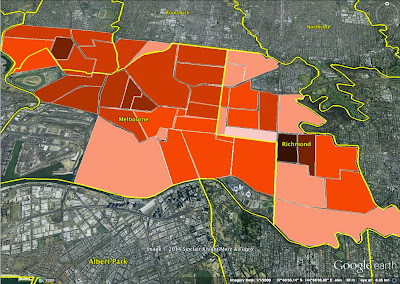
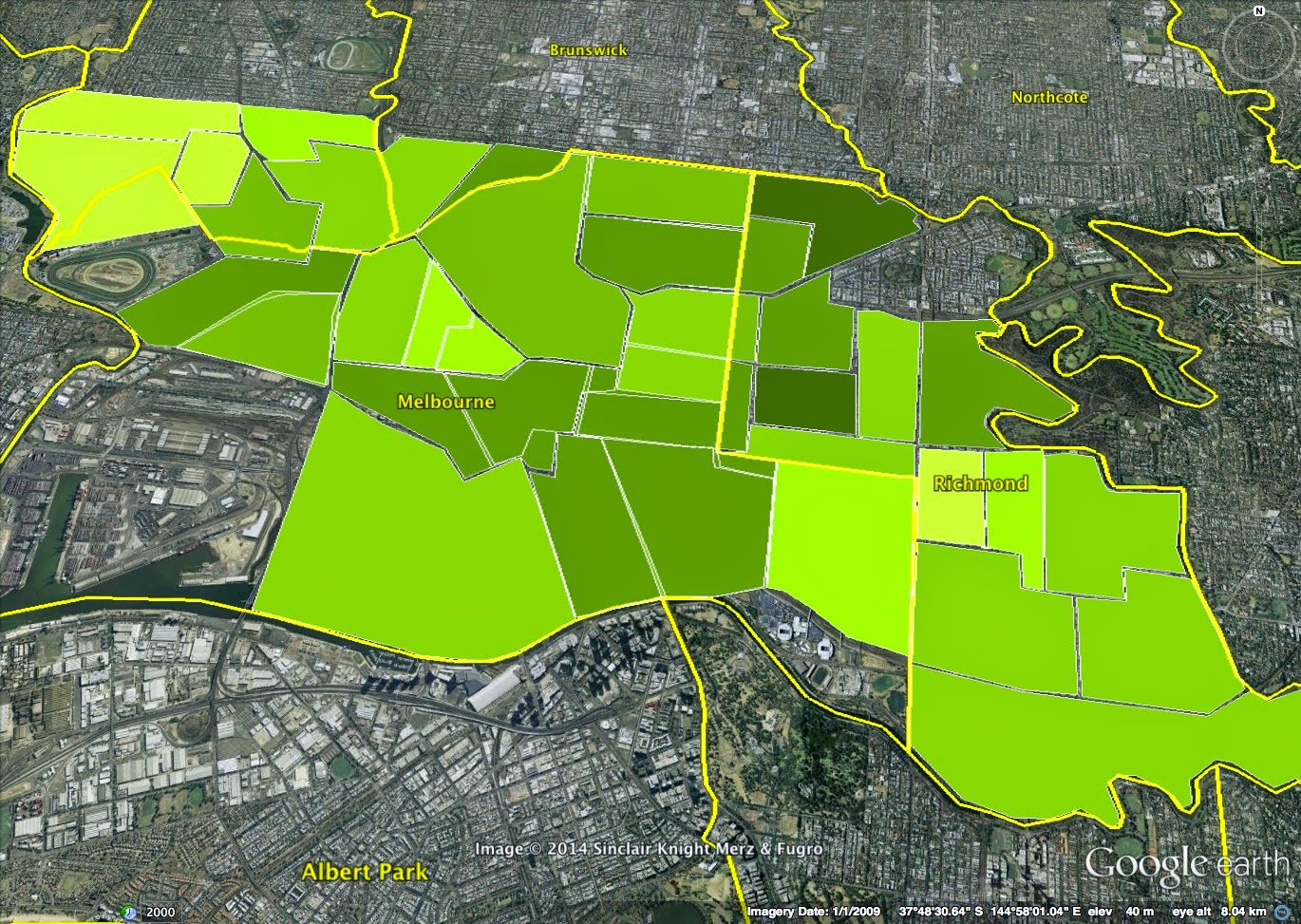
The remaining older charts show primary voting patterns (no 2PP) for Federal Elections 2013 and 2010 plus Melbourne State District Byelection 2012. State electoral boundaries are shown in yellow. Lighter red = lower ALP vote %. Lighter green = lower GRN vote %. Colours are consistent in their % representation across all images.

ALP Primary Vote, 2010 Federal Poll

ALP Primary Vote, 2013 Federal Poll

Indicating the huge decline in ALP votes in central, north and eastern parts of the electorate

ALP Primary Vote, 2012 State Byelection

ALP Primary Vote, 2010 Federal Poll, overlaid with State Byelection 2012

showing little shift in ALP primary vote between these polls in booths within the State District boundaries

ALP Primary Vote, 2013 Federal Poll, overlaid with State Byelection 2012

showing a huge decline in ALP primary vote between these polls in booths within the State District boundaries

GRN Primary Vote, 2010 Federal Poll

GRN Primary Vote, 2013 Federal Poll

showing significant increase in GRN primaries across Northern-Central portion of electorate

GRN Primary Vote, 2013 Federal Poll, overlaid with State Byelection 2012

showing a significant rise in GRN primary vote in the inner norrh portion of the electorate between the two polls - Carlton, Fitzroy, Fitzroy North, Parkville

Monday, 9 November 2015

The Best Thing Australia Can Do For The Global Refugee Crisis: Exit the Refugee Convention

Tony Abbott has managed to underscore his astonishing ineptitude in crafting a message for his audience on the largest possible stage this week.

Julia Gillard has followed up with a cringe -worthy interview for Al Jazeera where she appears to confuse the conditions on Manus Island with the benevolent welcome camps she found when she came off the boat herself in Adelaide.

But I really wish we could have a proper debate about the real issues here. Both Gillard and Abbott have failed dismally to grasp the moral nettle of the issue.

But behond all the commentary I've read to date sits a very core issue that's never really grasped either. And I think this is why it's proven such an intractable issue for us.

In essence, the disparate ideological positions are driven by the reality that Australia is tryjng to pursue an "orderly queue" by giving primacy to the UN resettlement stream ahead of irregular onshore arrivals.

That in itself isn't bad or regressive policy. The problem is that basically only the US, Canada and Australia take refugees from this stream.

Basically every other country on earth fills their refugee stream with irregular arrivals applying directly for asylum in that country.

Let's be clear. This is directly enabled and encouraged by the Refugee Convention under which an asylum seeker's best option is to transit at whatever cost to the wealthiest nation with the highest intake numbers.

This is very specifically NOT the Convention's original intention. Something needs to give. Either we need to re-work the global regime to give far more primacy to the UN resettlement stream or revisit the convention wholus bolus to remove the incentive for irregular trans-border movements.

For all the right wing hysteria it boggles my mind that we've never had an Andrew Bolt op-ed saying "Australia should withdraw from the refugee convention as an attempt to precipitate its reform." Then we could simply say "you can't apply for asylum to Australia IN Australia." So the boats.

Add a caveat for political asylum seekers should they arrive here with a valid visa and another that alowed for mass arrivals in the event of a real crisis in any of our neighbors.

Then we triple our intake from the UN stream. So we're being generous to the larger body of refugees, and nobody needs locking up anywhere, and we get this xenophobic mess out of the forefront of the national consciousness.

How's that sound?

Tuesday, 22 September 2015

Still Obsessing on Modes: Towards a New Socialism Part 2

A response to Tristan Ewins, proprietor of the ALP Socialist Left Forum blog.


I thank Mr, in fact 'Dr' now, it seems ... Tristan Ewins for his reply to my last blog, delivered with considerably more timeliness than I was able to muster. You can read his fulsome  reply HERE. Ewins takes issue with many of my prescriptions for a new socialism.

Ewins wonders why there is any sort of need for a 'new' project at all. To which I would answer there is the need to create a division with an 'old' socialism, very much in the minds of those people we seek to influence.

Let's remember that every socialist state turned into an authoritarian nightmare, and that today many notionally Communist/Socialist states (and that's not a nexus most people have the sophistication to break) are in fact just single-party state Capitalist economies, and those that aren't are basket cases.

Because that's the narrative 'truth' that we need to get beyond in order to render the idea presentable to the Cold War generation.


True: Ford and I agree on the need for “natural public monopolies”.  Ford is not specific, but for me here I think of energy, water, communications and transport infrastructure. I also think of near-monopolies in education.  But why not extend strategic socialisation beyond these strictly conceived boundaries?

Why not? Because you need a rationale for doing so. The idea that the Commonwealth Bank, Telecom Australia or Medibank provide/d some kind of market tempering force for equity within their respective markets is ludicrous. And not borne out by evidence.


The boundaries of government responsibility are what we're talking about, and Ewins rightly questions a number of the definitional boundaries raised by a new socialism. What I would say here is that the mode of analysis is still unnecessarily bound up in binary ideas of public versus private ownership, ie we're focused on the modalities, not the outcomes.


A new socialism should be wholly outcomes-focused. It should NOT see pursuing specific modalities for, say the provision of government services as any sort of inherently socialist project.

The examples Ewins raises include education - where we have mixed funding model, but with public funds often going to private bodies. Neoliberals should be screaming blue murder as much about this situation as they do about rigidities elsewhere in our political system. The new socialist case here would be to ask private schools and education providers to fend for themselves.

Similarly the public subsidy of private health insurance is a complete market perversion. The new socialism should have in mind what could be done with the billion dollar boost axing this would provide the public purse.


Aged Care - similar to education, we have a mixed model. You could argue equity and other outcomes would be improved by wholly public provision, you could argue the private sector is failing to deliver social outcomes completely. 


I wouldn't see government provision of aged care services to be in any way beyond the ambit of a new socialism. In fact, Government provision of services to the community which the market does not of itself adequately provide is a key tenet of the new socialism.


Ewans also raises the question of the mining super-profits tax - and indeed almost says it himself - this is a perfect example of socialisation through regulation rather than through direct ownership. In its original guise, it was the perfect new socialist policy vehicle.


Ewins also raises a number of issues around government support of Co-operative enterprises. I will start by saying that I think this is a very interesting area of activity for socialists IN THEORY. I think workplace democracy and community co-operative models are some of the more interesting tools in the toolbox that we, as socialists haven't properly played with yet.


But I will also say that people have been writing about this stuff since the sixties. And it really never seems to go anywhere. Co-operative enterprises aren't really a real world thing of any consequence right now. I'll set this aside, and say government finding ways to explore new corporate models is a potentially MARKET-LIBERATING activity, if you accept that current corporate structures are detrimentally rigid. Australian innovation in this area has been basically zero, so arguably an example of market failure. Once again, this is how an economist would put it, but she'd be saying fundamentally the same thing as the socialist.

I keep coming back to the point that the language and concepts we use as socialists would actually not be at all alien to a neoliberal. Neoliberalism at its heart makes the same claim as socialism - the maximisation of collective welfare. It's neoliberalism's MODALITIES that are deeply offensive to the socialist instinct.

I actually think the rationalists who want us all to prosper collectively are in the majority in public debate. We simply haven't had the language to talk to each other properly. Finding that language means finding socialism's spirit inherent in all areas of public debate, it means rediscovering socialism not as a revolutionary movement at all, but as a core principle inherent to the democratic instinct.


Ewins then says "Underlying rejections of a larger role for government is the notion that private ownership is “natural”. And on this point I need to be clear - I am NOT advocating a smaller role for government at all. I am advocating a better defined but greatly expanded one.

Ewins is right to say that we shouldn't "fetishise markets", but we need to be equally certain not to pointlessly demonise them either. The line that "neo-liberalism and the impact of market forces on areas of the economy they never had influence on before is the great evil that the modern Left needs to rail against" is lazy in the extreme.

I ask anyone with that analysis to make a list of the actual outcomes they are trying to oppose in one column and their policy prescription for it in the next. I guarantee whatever you map out, it will look nothing like a prescription that "markets are the problem", and "reducing the power of markets is the solution". Instead you'll have a complex set of interacting forces that are crying out for a body to address them. You have a need and a role for government. You don't have a program to "push back neoliberalism", you have a program to work with it to deliver specific agreed outcomes.


And for Ewins, as for myself, it's the definition of these outcomes that becomes crucial to agreeing what the entire socialist project is. And here, we really don't disagree at all.  Equal association, redistribution of wealth, and the creation of a "good society" are all good places to start. But I want something more fundamental, more defining.


Socialism's aim is the delivery of optimal SOCIAL outcomes. That means socialist analysis always occurs at the collective level - anything to do with the advancement of SOCIETY is, or should be its stuff.


What I'm trying to create is a dichotomy between a new socialism, which accepts a defined but expanded role for government, which accepts capitalism as a fundamental and untransgressible force and a revolutionary or utopian socialism that believes in some sort of "post-capitalist" system as if it has any clue what that would remotely even look like.

Thursday, 17 September 2015

Conversations with Mr Corbyn - Towards a New Socialism

Socialists: Have Beard, Will Travel. Picture excludes Luke Foley.

I suppose there comes a time in the life of a blog where it needs to come out from behind its mother's forelocks, be brave and start playing with all the other blogs.

Mr Tristan Ewins, proprietor of the ALP Socialist Left blog, recently posted up some big picture riffing on the question of socialism's mission there, and I did promise him a comprehensive reply in blog form. This is the first part in a series of posts which will attempt to address Tristan, in addressing Kim Carr, in addressing Luke Foley, in squeaky-voice henny-pennying over the edge of a political cliff with all the gravitas of a drowning ballerina.

But I also emerge here in hypothetical conversation with the hashtag of the moment Mr Jeremy Corbyn, whose elevation to the leadership of British Labour has offered socialism the prospect of a real elevation within the spheres of global political discourse.

THIS is an opportune moment that for socialists worldwide must not be missed. Now, the window of history is open enough and allows enough perspective, as divorced from the ideological blinkers that the Cold War fastened us in to, to actually learn history's lessons well,

The trouble, I think with this discussion is that it doesn't go deep enough. The questions here are really "What is Socialism?" and "is the ALP/Labour on a socialist project or not?" The first problem is one of definition, and an extensive exercise at that. The second problem is merely one of ideology once the first is answered.

So let's focus on the first, but I'd like to suggest a unit of analysis even bigger-picture. Because the point of asking these questions is locating from where on the political hillside Labor's light calls to it. The point here is surely not so much to map the present, as chart the future. The light on the hill is as a beacon, not a point of arrival. It guides us forward, rather than telling us where to stop.

"What can socialism be?" and "what COULD it mean for Labor in giving it political purpose?" These are the salient questions to be asking today.

Because we are in a moment, as Bernie Sanders and Jeremy Corbyn have stellarly proven, when suddenly enough time has passed since cold war mores held sway. There is now a generation of particularly younger folk in advanced western economies who are reaching out almost in desperation for a better brand of politics, one that displays considerably more of the heart and the humanism that 20 years of neoliberal discourse has expunged from the system.

There are also a good body of older people for whom the ideas of socialism never died, but were swamped under a sea of pragmatism when the Cold War ended. We all had to concede planned economies don't work, as if THAT was actually a core tenet of socialism that needed shameful jettisoning, and somehow that turned into a repudiation of the discipline, the word, the everything.

With an inescapable cloaking of anyone who went near the concept with all things Stalinist, grey, bleak and inhuman, we conceded effective defeat. And we were desperately wrong to do so.

Wrong, because we let our opponents, as victors, define the history of the battle. But if we can turn now, with 20 years of hindsight and say "Actually the metrics were wrong, the goalposts were never set around massive state ownership and related ideas, or at least they never had to be".

Because we are talking about OBJECTIVES here. How did we ever become so terminally focused on specific processes to attain them? The socialist objective must be to deliver OUTCOMES that adhere to socialist values, rather than known socialist STRUCTURES like state ownership of trading enterprises, whose outcomes do not. And when you start defining things in those terms, you wind up talking about things that actually fold very neatly into economic orthodoxy.

But it's not just we who need to become reconstructed, because the same deep untruths have become gospel to swathes of people who stand outside socialism's discourse. They think they've seen a corpse interred, but they're about to find out they only seeded Lazarus.

Where and when was socialism born? The correct answer is that it's been born and reborn a million times over. Why are we so obsessed by the writings of one German Jew on the matter? Because he ushered in socialism's greatest "modern/pre-modern" upsurge is perhaps understandable, but I feel this resultant obsession with Marxist structures and analytics has been a stright-jacket we've let define the meaning of the movement for too long.
I believe socialism is as much John Lilburne's as it is Karl Marx's to define. Or for that matter, MINE!

Socialism, like basically all great political ideas has its origins concommitant with the fitful birth of British democracy. And the location is no accident, because the conditions that made the land rife for socialism were all the byproducts of early capitalism. In part because England was the most developed economy on earth in its age, because with the complexities of interactions under capitalism, the complexities of the intellectual and public life were advanced also.

Socialism requires profound faculties of analysis - it requires that those at the tail end of a complex series of interactions to have a consciousness of the complete set of discourses they are operating under. It requires that they are able to mentally step outside their own conditions and radically conceive of something better.

It is time for a "New Socialism", one that takes as its foundation the restoration of the very set of values that huge swathes of modern society is clamouring for the political sphere to deliver, but one which has as much in common with ideas like state ownership as it does with laissez-faire capitalism.

It is essential that we succeed in the quest to define a new, post-modern form for socialism, and one which gives real effect to the movement’s long-abiding objectives, albeit through new forms.

Forms that would be completely alien to socialism’s architects and original dreamers, but which are in turn so because the tools I want to talk about ARE very much a product of and accepting of MANY of the precepts of modern, advanced, globalised market capitalism.

I want to disrupt the idea that any of these ideas exist in opposition to socialism. If socialism is the instinct to regulate capitalism, then we have learned some clear lessons about how best to do this.
  • Command economies are stupid. Really, really stupid.
  • This precept extends to government direct intervention in markets through ownership of bodies other than those which are natural monopolies.
  • So the role of government becomes not a tool for intervention in markets, but regulation of them. And provision of services and infrastructure the market would not otherwise provide. And democratic representation in all these areas.
  • And government could be far more aggressive in all these areas, and it’s socialism’s mission to ensure this happens.
  • And in the opinion of this writer it needs to be vastly more aggressive in its pursuit of socialist outcomes, and the feedback to the political system is screaming this at present.
So much of the criticism flung Mr Corbyn's way so far starts with the assumption that these lessons haven't been learned. We have the duty, in seizing the historical moment of opportunity to ensure that they have. We must ask of the likes of Jeremy Corbyn to drive the debate towards a "New Socialism", a globalised, post-modern, post-neoliberal, thoroughly refreshed idea.

Socialism is at its heart nothing more than the inclination to regulate capitalism. The tools to do so have never been more complex, global or powerful. Nor have they been ever more needed.

An exciting new era for socialists sits poised, waiting for us to march towards it. Who else can see this new light on our collective hill?

Saturday, 24 January 2015

The Battle for Inner Melbourne - By Colours

OK. So, about a week out from the State Election, I had this ready to roll off the presses. And then I thought about potential succour to the enemy, and I'm sure that's some sort of Federal offence now, although maybe not retrospectively, and goodness me where did I put my spectacles, and so forth  ... !! (keeping up?)

It's all based around this here analytics I've done using Google Earth, kind of geospatial representations of the ALP/Greens vote based on booths at Federal and State elections. And now I really am building up rather a useful volume of such material over successive polls, and no, you cannot have any.

The question I wanted to ask prior to the election was whether an extrapolation of Federal voting trends in Melbourne FEA was already evident in the trend figures at the State level, and if so what was the likely State result?

You can see this below in pretty pictures. The regions are based on estimated likely voter catchments for each of the state and federal polling booths. The shades are based on each party's PRIMARY vote as a % of the total # of votes cast.

 ALP 2012 VIC BY-ELECTION

ALP 2010 FEDERAL ELECTION

ALP 2010 w 2012 OVERLAY

So, the first thing we see is that the ALP's primary vote at the by-election was a very close match in profile to that it obtained at the 2010 Federal poll, implying voters largely stayed with Labor across the two polls.

 ALP 2013

ALP 2013 w 2012 OVERLAY

The picture is very different relative to the 2013 poll, in fact the decline in Labor vote between the two Federal polls appears to have been almost cruelly centred on booths within the new geographic boundaries of the state seat. This should have been the first warning to the ALP that Jen Kanis in particular was in trouble. Our worst booths at our worst result ever, Federally, now comprised the core of the State District of Melbourne. Jen won 2012 mightily against expectations at a by-election that drew a record low voter turnout and without any Liberal candidate on the ballot.

It seems clear now looking at the above alongside the result of the 2014 election, that Labor effectively likely started from a point of needing a sizeable swing in order to hold the seat.

Green 2010

Green 2010 w 2012 Overlay

Looking at it from the Greesparty's end of the tube, once again, we see very little divergence between the two maps -the Green vote was largely constant from 2010 to the state byelection. Where I have effectively made the assumption above that of those voters who failed to turn out at the by-election, a majority are likely to be Greens, perhaps this actually indicates it was just the Liberal voters who stayed away, a finding that does make some intuitive sense.

Green 2013

Green2013 w 2012 overlay

And this image would likely give more cheer to the Greens' position, as a repeat of the 2013 vote would see the virtual northern half of the state seat (and the smaller cells there indicate that's where a large majority of the voters reside) swing strongly Green.

So. What really happened, then?

Well, all the new lot of pretty pictures that ought to be here are currently ontologically situated somewhere between my crashed hard dive and oblivion. Waaaaaaaa. Nonetheless, let me resort to baggage-laden, un-net-friendly words and reveal everything....

The results in both cases read almost exactly as if halfway between the 2013 actual and the 2013 with 2012 overlay. What's that mean in plain language? We see in evidence an enduring swing TO the Greens and AWAY from the ALP since the 2010 federal election, but that swing has been significantly mitigated since then. Nonetheless the ALP's core vote remains at losing levels (assuming Liberal preference flows were to stay constant) in the state boundary. Would the addition of Labor-held Richmond and parts of Essendon be enough to tip the scales and say "it's neck and neck in Melbourne"? Unlikely on sheer weight of numbers. The state districts of Melbourne and Richmond are 90% of the Federal FEA, and Richmond was a near enough run thing itself.

But we've established State vote is a reasonably good proxy for Federal vote in this seat, if not to much time has elapsed between, there is real grounds to say the process of the rehabilitation of the Labor brand in inner Melbourne is at least SOMEWHAT underway.

So there is much work yet to be done, but plenty more lessons to take away from this. Lessons I'm not inclined to cast afore the swine of the internet at large. The nub end of my analytics if for comrades alone, shoot me a message, prove your membership creds, and we might continue this conversation over your beverage of choosing ...