

"Melburnians, it's a GREAT time to be a suburban orbital rail enthusiast."
- The Bloodied Wombat, March 13, 2017

"BAPTISE this city, Mr Premier, with your heavy rail holiness!"
- The Bloodied Wombat, August 28, 2018.
And while we always thought the politics of such a project would be good, we've been blown away by the real enthusiasm with which the public has embraced the vision. Alan Davies has been telling me this was a stupid idea for as long as I've been discussing it, but his recent commentary has really been the outlier in pouring scorn on the project's mooted benefits.
I'd like to return specifically to some of Alan's concerns in the concluding blog to this series. But first, let's take a look at the project as it is currently proposed, and make an assessment of the logical "next steps" in project planning to ensure we return maximal benefits from the project for all Victorians.
- In part one here today, we'll look at the majority of the network, and the portion most likely to be delivered as tunnel - from the Frankston line through to Craigieburn.
- Next week, we'll look at the remainder of the network through the western suburbs and how the delivery and timetabling options and imperatives out there actually look very distinct to the underground portion of the network.
- In part three we'll look at some rudimentary cost-benefits and respond to some of the common critiques of the plan as well as look at some further incremental developments to consider to address any major goals this orbital rail plan is unable to, and so deliver a maximum benefit metro style heavy rail system for Melbourne.

i'M SORely what Melbourne needs
For starters, we need to do something about an acronym. The notional Wombat project suffered a little from nomenclature overload, usually going by some variant of "Urban Orbital Rail" and "Suburban Rail Loop". Other commentators seem to have just settled for the obvious - the government document is entitled "Suburban Rail Loop Strategic Assessment", so SRL it is.
I'm probably a little bit tragic in this regard, but I look at that acronym and the only words that enter my dyslexic head are "Stevie Ray Vaughan". So I think we can and should do better. A loop is necessarily orbital, so we can turf one of those two words, and I think it needs a bit more LOCAL, yokels. So I'm going with Melbourne Suburban Orbital Rail or MSOR, and you'll just need to adjust your sets accordingly.
Orbital Rail Benefits - Recapped
It's all about the network effect. Human civilisation's greatest quantum advances have all taken place as a result of technology that enhanced our ability to network together as human beings. The invention of railroad itself is but one critical illustration of the phenomenon.
We've seen in an earlier blog that Melbourne's existing employment centres map very neatly to the established heavy and light rail network (image below), and it's important that we state from the outset that the PRIMARY goal of MSOR, in order to make the project stack up cost-benefit wise must be the facilitation of transport movements radially IN to designated suburban employment centres.
 |
| Melbourne Employment Densities and Centres with Tram/rail Networks |
The main benefit of the policy - the entire point of spending $50bn is to purchase the necessary enabling infrastructure to allow us to build the ever more mythologised "20 minute city". The point of this MUST be a radical re-envisaging of the MAJORITY of suburban employment journeys to enable a significant mode shift to public transport.
We've estimated previously that as many as 200,000 more Melbourne commuters hop in their cars DAILY for the journey to work than their Sydney counterparts, and tendered significant evidence that the less radial nature of that city's heavy rail network was the most obvious source of this.
But we also simultaneously discussed the ways in which Sydney has done a far better job of the planning side of the equation - on facilitating remedial land uses and attracting employers into rail-enabled locations.

The real beauty of orbital rail as imposed on the existing radial network is that it creates innumerable opportunities for multiple heavy rail "spokes" to operate radially IN to the new suburban employment centres, over-writing Melbourne's current hugely dispersed suburban employment patterns with a new map that creates a critical mass of employment destinations walkable to heavy rail stations.
And where the heavy rail network previously left enormous public transport blackspots across Melbourne's eastern suburbs, the networked, web-like lattice into which it is transformed by MSOR means that vast swathes of the east in any given direction are now just a few train stations from the new employment centres, whereas previously a commuter in Box Hill would have needed to travel in to Richmond and then out again to get to Glen Waverley, around tripling the necessary travel distance versus car.
That this is not a high demand journey today is not the point, the above shows exactly why the demand isn't there.
 |
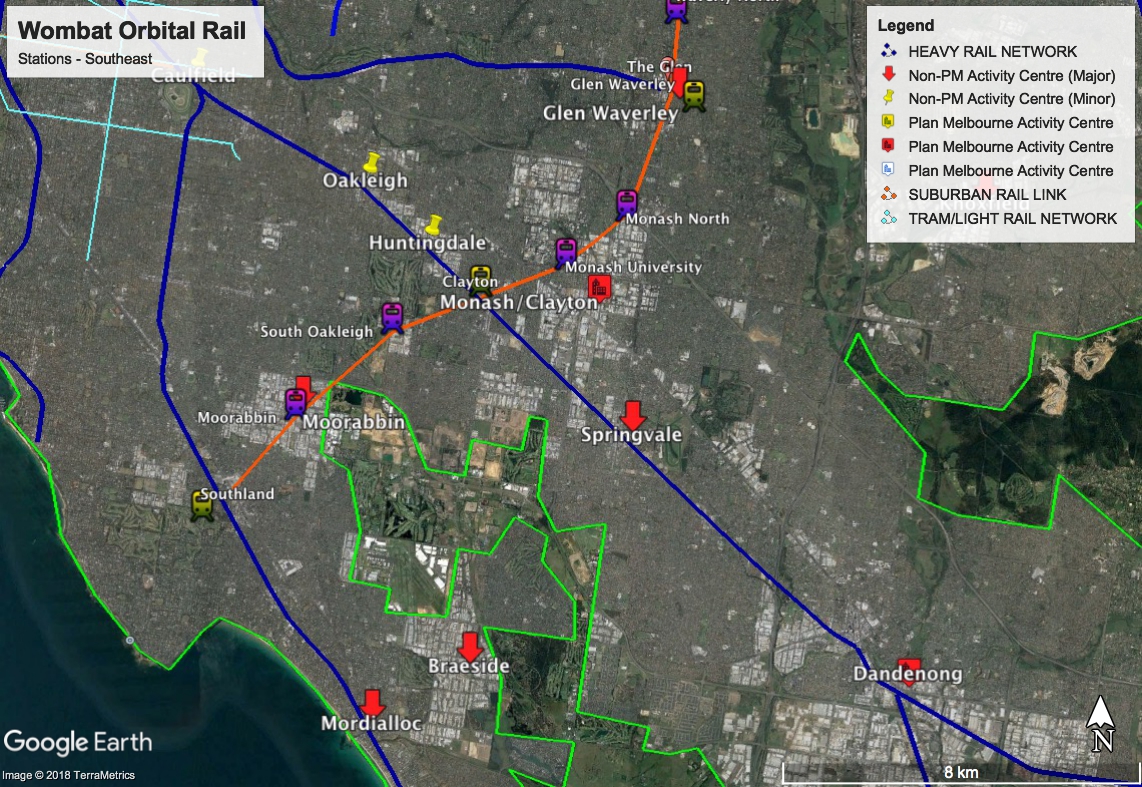
| Wombat's Melbourne Suburban Orbital Rail Route - Southeast (orange) |
We're planning here for Melbourne 2118, from which vantage point, this project will be deemed to have paid for itself several times over. In the same way we'd decry the insanity of ripping up any of our established lines today (and again, the Upfield line would never have stood up to Infrastructure Victoria's methodology if proposed today, as they would assume it would cannibalise 60% of its ridership from the Craigieburn line).
Not Because It's Easy, Because It's Hard
It's very important that we convey that it is NOT POSSIBLE to do the cost-benefit calculations on MSOR, without first calculating the potential benefits for re-shaping land use, employment and transportation patterns all along the corridor. And you CANNOT do that calculation without doing ALL the detailed planning on exactly where the stations are going, how much viable land exists around the new station for consolidation into an urban activity centre, what the potential of that location is as an employment destination, and so on.
In short, the potential of MSOR is less as a pure transportation project and more as a tool to guide land use and strategic planning. Because if history teaches us humans anything - we have two great assets as a species which have enabled all the marvels of our civilisation down the ages. One of those is our ability to network together with our fellow human beings. The other is an ability to plan collectively and work strategically towards a long term goal.
We've only got to where we are as a species by incrementally envisaging better worlds in exactly this fashion. MSOR is a project that dials in a very specific vision of a better world and then goes about planning for it.
Thus is Melbourne Suburban Orbital Rail the very acme of visionary, big picture human undertakings such that truly elevate one's eyes to the horizon, that actually do make a body ever so slightly proud to be a tiny chapter in humanity's infinite history.
Optimising the Route
The initial Strategic Assessment provided by Development Victoria leaves largely open the question of how many new stations will be included in the project, instead nominating a number of broad locations that are intended to be served, as well as indicating the likely interface stations with the existing network.
So, let's look at the Wombat-optimal suggested solutions to some of the core issues. Let's map out an actual proposed network, starting in the Southeast.

Our considerations here are really threefold - to cater to established employment centres currently poorly served by public transport - to facilitate enough new employment centres in order to render the 20 minute city concept feasible - and to provide new commuter stations in existing rail black spots.
We raised in an earlier post our concerns that Plan Melbourne actually fails to designate enough activity centres with enough geographic spread to come close to enabling the 20 minute city it waxes so lyrically about. That concern was overlaid by a sense that not much actual practical policy existed to facilitate the creation or agglomeration of employment or activity centres outside of the small number of headline locations.
We strongly suggest that enabling legislation should be considered for this project which grants full control to the Planning Minister for any planning issues within specified distances around the station sites - with their scope/size roughly scaled according to the 'site potential' ratings suggested below. We'd suggest doing the same for ALL the station sites in yellow and red in the map above.
We would then suggest either a new standalone body, or something within Places or Development Victoria which is responsible for involving stakeholders and developing masterplans for each of the zones, which may or may not have some responsibility for actual land acquisition or consolidation of sites as necessary. It would ideally have a charter to ensure that sensitive or heritage neighbourhoods were preserved, and that larger scale or higher intensity development were focused away from residential areas, but the body's charter would essentially be to develop these areas as employment zones.
Where the government has already nominated value capture as a key potential funding source for the project, we'd suggest you've already taken several large steps towards the need for just such a body or bodies to be established anyway.
Finally, we'd LOVE to see some sort of incentive scheme for large employers currently located a long way from public transport be facilitated to relocate to these new activity centres, and the owners of those large industrial sites be given incentives to redevelop those as residential or other beneficial re-uses.
Which Way South?
Regular readers will recall that the Wombat Plan last left this concept with two feasible N-S routes through the eastern suburbs - an inner AND an outer connection and actually advocated the staggered construction of both. The inner route is largely the one as put forward by Development Victoria. The outer route ran via Doncaster to Ringwood then on to Knoxfield, Dandenong, Braeside and Mordialloc.

The outer route was mostly about enabling rail to those several existing centres, which it should be more than a footnote here, are still probably crying out for some form of enhanced public transport solution on the basis that it's much harder to start an entire new employment centre than to better plan for an existing one.
I'm a little heretical amongst transport buffs, in that I view "park and ride" models for heavy rail into suburbia as a very major success factor in improving the overall mode share for public transport in Melbourne, and accordingly the park and ride potential of the various sites is something we'll be considering in some detail.
I should apply my usual caveat in that the first-best option is obviously having suburban bus or even new light rail services operating super-frequently in to the station from local destinations as feeders to the heavy rail system rather than cars. The extent to which further such enabling policy were put in place would actually have a serious impact on the size of the potential benefits column for MSOR, and so obviously the issue warrants addressing.
But one of the issues this project contends with is that it is retrofitting a european style heavy rail metro into areas with significantly lower population densities than much of Europe, and in order to plan realistically for final yards travel in a city that has never had a good relationship with its suburban bus network, we simply need to factor cars in for the foreseeable future.
Optimising the Station Locations
Urban Melbourne recently carried some good commentary showing what the development pipeline looks like in the suburbs slated to receive MSOR. It can be quite illuminating to read alongside my proposed route. When you get a sense of the quantum of change that is already happening, the benefits of this project appear to be as much in being able to actually take direction of that change as they are in facilitating anything new.
SOUTHLAND STATION - FRANKSTON LINE JUNCTION
Site potential: A
Park and Ride Potential: B
The first question arises at the bottom of the 'clockface'. The Strategic Assessment resolutely states that the route is intended to meet the Frankston line at Cheltenham. This has, however, widely been interpreted as actually meaning "Southland" station, and we would very much encourage the latter.
One need only look at the land usage around the shopping centre, even before thinking about further possible apartment towers on top of the shops to know which site has the greater redevelopment potential as an employment/activity/residential centre. We embark at Southland.
Unlocking the park and ride potential of the site, given it is surrounded by residential areas would be a key success factor, and this would obviously be dependent on arriving at a mutually beneficial arrangement with Westfield to utilise the existing parking areas.

MOORABBIN STATION
Site potential: B
Possible Location: Blamey and Nelson Rds
Park and Ride Potential: D
Moorabbin represents one of the few properly established existing employment centres that we are adding to the heavy rail network, so the proposed location is really at the heart of the industrial zone.
We would suggest significant scope exists, given the large nature of the landholdings in the area to create a small central retail/hospitality zone around the station, but this would not be an attractive location for residential redevelopment at scale. Moorabbin's role would remain primarily as an industrial-style employment zone, and as such park and ride is a lower priority at this location.
SOUTH OAKLEIGH STATION
Site potential: C
Possible Location: Huntingdale and Centre Rds
Park and Ride Potential: B
South Oakleigh is currently a small scale employment zone, which has appreciable redevelopment potential for potentially some more intensive scale office and retail developments around the new station. It is also bounded by significant residential areas, so we would suggest some property acquisition to enable construction of a park and ride structure would be a key success factor.
CLAYTON STATION - DANDENONG CORRIDOR JUNCTION
Site potential: B
Park and Ride Potential: C
This station has always been at the fringe of the actual employment zone, so its catchment contains a mixture of residential and commercial sites with some consolidation potential as the broader employment zone develops.

MONASH UNIVERSITY STATION
Site potential: D
Possible Location: Around the site of the current bus terminus at the Southern end of the campus
Park and Ride Potential: N/A
The core reason why this station has scored so low on the site potential rating, is that locating the station well for on-campus purposes renders its potential to cater to surrounding residential and employment areas minimal, and because we can't be stopping the trains every 500 meters, forces us to place the second new Monash precinct station in a sub-optimal location for unlocking the maximum potential value of the precinct.
The potential to reduce car dependency amongst the campus' 30,000 odd students and academics is significant enough that these issues are obviously unavoidable, and accordingly park and ride would be inappropriate and unworkable here.
MONASH NORTH STATION
Site potential: A
Possible Location: Dunlop and Springvale Rds
Park and Ride Potential: B
Again, this is probably not the optimal location from a broader precinct planning perspective - so if forced into a site like this, the precinct planning should obviously do what it can to try and develop something of a walkable town centre in the vicinity the station.
GLEN WAVERLEY STATION - JUNCTION
Site potential: B
Park and Ride Potential: C
An established site obviously, does a reasonable job catering to the adjacent Glen shoppping centre, and has a reasonably good residential catchment with a small number of commercial sites nearby providing some redevelopment opportunity.

Site potential: D
Possible Location: Springvale Rd
Park and Ride Potential: B
An entirely residential area, this station would be a purely commuter station, and therefore sufficient landholdings to enable appreciable park and ride would need to be considered.
BURWOOD EAST STATION - #75 TRAM INTERCHANGE
Site potential: B
Possible Location: Burwood Hwy and Springvale Rd
Park and Ride Potential: B
A great opportunity to develop a more pedestrian-friendly mixed use zone around this intersection, where the 75 tram also forms another two "spokes" into a possible employment hub, and where the size of the land holdings thereabouts offer decent scope for renewal, we would urge strong consideration be given to giving this potential employment hub much more focus than it might appear to warrant at first glance.

BLACKBURN STATION
Site potential: D
Possible Location: Blackburn Rd
Park and Ride Potential: B
An entirely residential area, this station would be a purely commuter station, and therefore sufficient landholdings to enable appreciable park and ride would need to be considered.
MIDDLEBOROUGH STATION
Site potential: C
Possible Location: Middleborough Rd
Park and Ride Potential: B
Another site with some established commercial/industrial and good potential for an actively planned mixed use precinct.
BOX HILL STATION - LILYDALE/BELGRAVE JUNCTION - #109 TRAM INTERCHANGE
Site potential: A
Park and Ride Potential: B
Box Hill station, as poorly integrated as it is with the existing shopping centre and bus/tram interchanges, presents a real opportunity, if the long mooted complete re-build of the thing were still on the cards, then Box Hill unquestionably has the greatest potential of any eastern suburbs site on the MSOR for an effective high density residential, office and retail hub.
However, the issues relating to transport connectivity would need some really good planning around them to maximise the opportunity here. We should also seriously consider the extension of the 109 tram along Whitehorse road to provide a new rail "spoke" into this highly significant potential activity centre.

SPRINGFIELD STATION
Site potential: D
Possible Location: Springfield and Dorking Rds
Park and Ride Potential: B
An entirely residential area, this station would be a purely commuter station, and therefore sufficient landholdings to enable appreciable park and ride would need to be considered.
Specifically situated to titillate Simpsons fans.
DONCASTER STATION
Site potential: A
Possible Location: Shoppingtown
Park and Ride Potential: A
Another established shopping centre and major bus terminus with significant surrounding residential, including some medium-high density as well as commercial and industrial. Excellent potential for effective creation of a medium-high density mixed use zone, which would posit interesting challenges in needing to make an effectively private space (the shopping centre) the town centre.
WEST DONCASTER STATION
Site potential: C
Possible Location: Doncaster Rd & Eastern Fwy
Park and Ride Potential: B
Some small scale nearby retail, but a mostly residential area, and thus this would primarily be a commuter station.

BALWYN NORTH STATION
Site potential: D
Possible Location: Bulleen Rd & Eastern Fwy
Park and Ride Potential: B
An entirely residential area, this station would be a purely commuter station, and therefore sufficient landholdings to enable appreciable park and ride would need to be considered.
HEIDELBERG STATION - HURSTBRIDGE JUNCTION
Site potential: C
Park and Ride Potential: C
As an established station servicing a sizeable mixed use retail, commercial and medical precinct, it offers limited scope for additional park and ride, nor would we really want to encourage that near an established retail shopping strip.

HEIDELBERG HEIGHTS STATION
Site potential: C
Possible Location: Edwin and Bell Sts
Park and Ride Potential: B
Largely residential area, some small scope for enhanced commercial along the main roads in the vicinity.
NORTHLAND STATION
Site potential: B
Possible Location: Northland S/C
Park and Ride Potential: C
Largely established industrial area, but as industrial does offer reasonable scope for future precinct planning. A core challenge here again would be to effective activate anything beyond the shopping centre - perhaps the best realistic outcome would be a mixed use development of the existing shopping centre.
WEST PRESTON STATION
Site potential: C
Possible Location: Waterdale Rd
Park and Ride Potential: C
This is an existing small scale industrial area south of La Trobe University, and as such offers tremendous opportunity for creating a transport-oriented employment precinct either allied or independent to the University

LA TROBE UNIVERSITY STATION
Site potential: C
Possible Location: Somewhere near the Agora
Park and Ride Potential: N/A
The issues here are similar to Monash, except the larger distances mean that station location doesn't really force compromises elsewhere, although it won't be a long way between stops to Plenty Rd ...
BUNDOORA PARK STATION - #86 TRAM INTERCHANGE
Site potential: C
Possible Location: Plenty Rd
Park and Ride Potential: B
Some larger dispersed commercial and industrial sites along Plenty Rd. The large amount of surrounding parkland makes this a less than ideal point for the actual interchange with the tram, and so we suggest positioning the station to attempt to garner the largest residential catchment for the station.
THOMASTOWN SOUTH STATION
Site potential: B
Possible Location: Cheddar Rd & Hanrahan St
Park and Ride Potential: B
Thomastown is a kind of sprawling, lumbering semi-industrial suburb that was absolutely gutted by the 1990s recession - having been home to enormous swathes of now vanished manufacturing. The area is only really just now starting to re-make itself, and it has enormous potential for re-development of almost unlimited scope, scale or use.
THOMASTOWN STATION - MERNDA JUNCTION
Site potential: B
Park and Ride Potential: B
Surrounded by variously industrial, retail and residential zones, Thomastown Station offers significant potential for the creation of an effective mixed use neighbourhood, and in fact if we were grading the prospects of the activity centres, we think no other such centre presents so high a potential with the addition of orbital rail. As we can see, it's possible to create fully 3 stations (2 new) which are very well located to create a large scale, medium density mixed use suburb. We strongly suggest Thomastown needs to rise up the activity centre priority list accordingly.

THOMASTOWN WEST STATION
Site potential: C
Possible Location: Ring Road and Mahoney's Rd
Park and Ride Potential: B
Although this station would have a large residential catchment, it would also serve the eastern end of the larger industrial sites situated between Mahoney's and the ring road, providing some further redevelopment opportunities across the wider Thomastown activity centre.
CAMPBELLFIELD STATION - UPFIELD JUNCTION
Site potential: B
Possible Location: Camp Rd
Park and Ride Potential: B
Significant planning has already gone in to re-instating the former Campbellfield Station, which closed in 1956. In fact provision was made for the station during the recent level crossing removal, and this is an obvious urgency. It's long been an incredible frustration for users of the orbital smart bus routes that because of this station's absence they don't actually connect conveniently anywhere with the Upfield line. There are significant industrial, commercial and retail sites in the vicinity of the proposed station, including Campbellfield Plaza, such that the potential for developing an effective mixed use neighbourhood around the station is quite high here.
BROADMEADOWS STATION - CRAIGIEBURN JUNCTION
Site potential: A
Park and Ride Potential: A
Broadmeadows is obviously one of the main designated activity/employment centres under Plan Melbourne, around which extensive work on future land use planning and so on is already underway. We will look next week at the possible infrastructure issues around the station, where it is anticipated this would be the point that we finally rise above ground since we first hopped on at Southland, from this point, we need to share some infrastructure with the existing network, so we'll discuss that next week.

Profiling the New Stations
We could break all these down by typologies relatively easily and these would determine what type/how much enabling policy you put around facilitating new uses for each, looking something like the following. If we throw in a few of the western suburbs stations to complete the picture, we're looking at something like the following:1. Designated Employment Centres
Broadmeadows
Box Hill
Monash/Clayton
Airport
Sunshine
Footscray
2. Existing or Potential New Employment Centres
Thomastown
Campbellfield
Burwood East
Middleborough
Moorabbin
South Oakleigh
Glen Waverley
Northland/Heidelberg West
Sunshine North
Keilor Park
3. Universities
Monash
La Trobe
4. Shopping Centres
Doncaster
Southland
The Glen/Glen Waverley
Airport West
Northland
(THINK about it - you will be able to shop 5 massive malls in 1 day with 1 Myki (or 2050 equivalent))
5. Residential/Commuter
Waverley Nth
Blackburn
Springfield
West Doncaster
Balwyn Nth
Heidelberg Heights
Bundoora Park
Keilor East
So that gives us around 20 "destination" stations, and we contend that this is number is much closer to the optimal number of activity centres than the last version of Plan Melbourne posited, if we are to enable a "20 minute city" in more than rhetoric. We contend that facilitating these new land uses and transportation patterns in to them is a goal so important that it is worth spending $50bn over an extended timeframe to solve. But more on that in part three.
Be sure to tune in next week, and we'll look at the western portion of all this in a lot more detail, as well as consider what a Melbourne rail timetable might look like in 2050, once all of this is up and running.
As usual questions, comments and critique are welcome - we love hearing your feedback!


