Showing posts with label socialism. Show all posts

Wednesday, 9 December 2015

Is Global Capital Building A New Socialism? 5 Astonishing Charts ...

PART 1. On Misery as the Human Condition


The pace of human advancement is increasing exponentially.

Most human beings who have ever lived have not enjoyed what we would today consider the most basic of freedoms. The vast majority of human beings that have EVER lived have NEVER been active participants in a democratic society or even in an effective economy.

Democracy as we today understand it, has largely been a privilege accorded only the citizens of wealthy western nations during the past approximately hundred years. The franchise until the French and US revolutions was the privilege of only wealthy male landowners in very few societies, and was only extended to women anywhere in the twentieth century. The concept has been basically alien to the experience of every arab born to this earth and not inclined to emigrate.

Over the 2.6 million years humans have existed on this planet, democracy has been a defining and significant factor for at best the last 100 of those, and even then far from universally. So using a VERY rough calculation, that's 0.038% of the human lifespan which has operated even broadly speaking under democratic conditions.

In 1820, with the main economic impact of the Industrial revolution still to be realised, the vast majority of people still lived in extreme poverty, with only a very small number of social elites possessing any appreciable wealth at all.

Since 1820, the human population has increased SEVENFOLD, yet measures of both absolute and relative poverty have proceeded BACKWARDS pretty much continuously over the same time.

The UN's Milennium Development Goal was to HALVE the numbers living in extreme poverty by 2015. In other words in the year 2000, the aim was to HALVE the numbers of the world's extreme poor, a status that the majority of human beings have lived under for 2.6 MILLION years in just the next FIFTEEN.

It sounds impossibly ambitious,  but now 2015 is with us, what's been the upshot? How far short did we fall? Well, the target, you may be surprised to hear was MET, and was actually met FIVE YEARS EARLY in 2010.

The absolute number of the world's extreme poor has been HALVED in the space of just ONE DECADE, and the foundations of Capitalism weren't shaken by one solitary micron in the process.

Now, if the elimination of poverty is not the one core goal at the heart of socialism, then socialism possesses no goal at all. But every significant reduction we've ever seen in levels of human poverty over a sustained (better than ten year) period has taken place under capitalist regimes. Socialist systems might prevent relative inequalities within societies, but not between societies, which is why we need to look to absolute rather than relative measures of poverty to assess what has truly occurred.

Chart One - The Recent and Rapid Rise of Democracy

So, chart one highlights this most particularly if you consider there's 2.59 million years missing at the left end of the chart. But you can extrapolate those.

It also highlights just how great a tipping point World War Two, or more correctly its end, has been for human advancement. We'll return to this date time and time again when we look at the historical patterns across several key metrics.

PART 2. On the Advent of Global Capital


It comes as no accident that historians identify the period following the second world war as a distinct and crucial "second wave" in the process of globalisation. Chart one shows us that as the planet has become more globalised in its interactions, so it has become more democratic too, and at a rate that appears to coincide with this same proliferation of more globally mobile capital.

Many have struggled for generations to achieve things any being on earth can now do at the touch of a button. And this has been a direct function of the exponential advancements in human science and technology that have occurred since the Enlightenment, but which we feel even now are only just beginning to escalate around us. The rate of advancement was positively glacial from the Enlightenment to the Victorian era when viewed relative to what we've achieved since, and we certainly don't have a sense this is slowing down.

Chart Two - The Recent and Rapid Rise in Human Life Expectancy

Average human life expectancy at birth in the Paleolithic is estimated to have been around 27-31 years. By the year 1900 it was still around just 31 years. So that's no appreciable progress in one of the core metrics of human development for the first 2.6 million years of humanity's history.

By 1950, life expectancy had finally begun to rise for the first time, and has grown exponentially since. In 1950 we expected to live 48 years, come 2010 and we're now living on average over 67. And of course the average is even higher for advanced western economies.

The overwhelming majority of people who have ever lived died unpleasant and by our standards premature deaths. So few old men have ever passed comfortably in their sleep. The mass of people down the ages who have passed what we would recognise as miserable and uncomfortable existences is just unfathomable, and  modern socialists would rail at the injustice of every one.

But after 2.6 million years of no change, we've more than doubled human life expectancy in the last 100 years, with over half of that occurring in the last 60, again accelerating at a similar pace. It appears by any rational analysis as though it took the enabling complexities of advanced global capitalism that were ushered in after World War I to achieve this, and those of the second wave of globalisation to truly accelerate it.

However, by way of secondary evidence, these life expectancy tables are vastly uneven, dominated in the upper ranks by wealthy mostly western nations and in the lower conspicuously by the world's poorest. The number of sub-saharan African nations performing below par is staggering.


Charts Three and Four -
The Highest Life Expectancies Worldwide are Found in the Most Advanced Economies

If this is somehow a message that capitalism is failing the world, I'm missing something. A country's level of economic activity appears to directly and positively correlate with the health welfare of the nation's population. And once again, if this metric isn't at the very heart of socialist concerns, what are we even doing here?

But even allowing for this relative inequality, and even lagging against outcomes in the developed world, we've still seen an enormous and significant improvement in African life expectancy over the same period, just not at the same pace.

And one doesn't need to dig too deep into the development literature in explaining this. The enormous recent improvements in African health are widely regarded as a function mostly of global welfarism, as delivered via NGOs and the WHO, rather than a direct function of economic development, which in this part of the world has lagged behind the trend improvements in life expectancy.

PART 3. On Socialism Under Postmodernity


So, perhaps there is a message here about capitalism and its failings. If a globalised welfarism is driving improvements in key measures of equity in the developing world, and if it is doing that because economic development in this part of the world is structurally ill-equipped to the task (being artificially constrained by factors political, technological, environmental or structural to below global trend rates of development), and if it's the surplus wealth found in advanced western economies that is necessary to enable this welfarism, and let's not understate the contributions of Bill and Melinda Gates here by way of a mere example, what happens to our objectives as socialists if we lift our eyes to the internationalist rather than the local sphere?

It seems incontrovertible to me that the issues tomorrow's socialists are going to be concerned with revolve around issues like
  • Ensuring global corporate tax compliance, and effective global corporate regulation
  • Ensuring factors like the level of corporate taxation and regulation do not become a 'race to the bottom' between nation states, for a strong and capable state will be core to enabling the fullest possibilities of a 'new socialism'
  • Building unionism internationally, rather than in a geographically-constrained locality
  • Developing measures for the global taxation burden to be shifted from personal incomes and corporate revenue towards CAPITAL ACCUMULATION, where in a post-Piketty world it's the higher sanctioned returns on capital versus on labor that can be seen to be driving global inequality
We are accustomed to being told that by the clock of the earth's lifetime, if it were compressed into a single day, then our existence on earth represents the final minute of that day, and our modern existence the final second.

The lesson of this seems to be that the enabling dimensions of complexity can be powerful drivers for the advancement of any species, so the complexity of the human brain has enabled our development from tribal to modern society, but our exponential latter day development has seemingly been enabled by the increasingly global level of interconnetedness.

It's the fact that all these brains are able to communicate, to pass information to one another, to develop systems for the retention of and access to the accumulated weight of human knowledge, that has essentially driven the formation of modernity. And it's from this point that we've witnessed our lifespans and collective welfare increase exponentially.

So, if socialism's goal is human advancement, the enhanced global complexity and interconnectedness of human interactions must be a key objective towards attaining that goal. And that of course prescribes support for enhanced globalisation, and for internationalist, in contrast to regional modes of organisation.

Technological advances in the twenty first century are now able to achieve global scale almost instantaneously. Immunisation programs now draw on years of accumulated research into their effective deployment. Powerful globalised organisations like NGOs have been able to deliver welfarism to the African continent in the ABSENCE of effective local governance and welfare.

UNESCO has calculated that in the next 30 years more people will receive formal education than in all of human history thus far.[72]
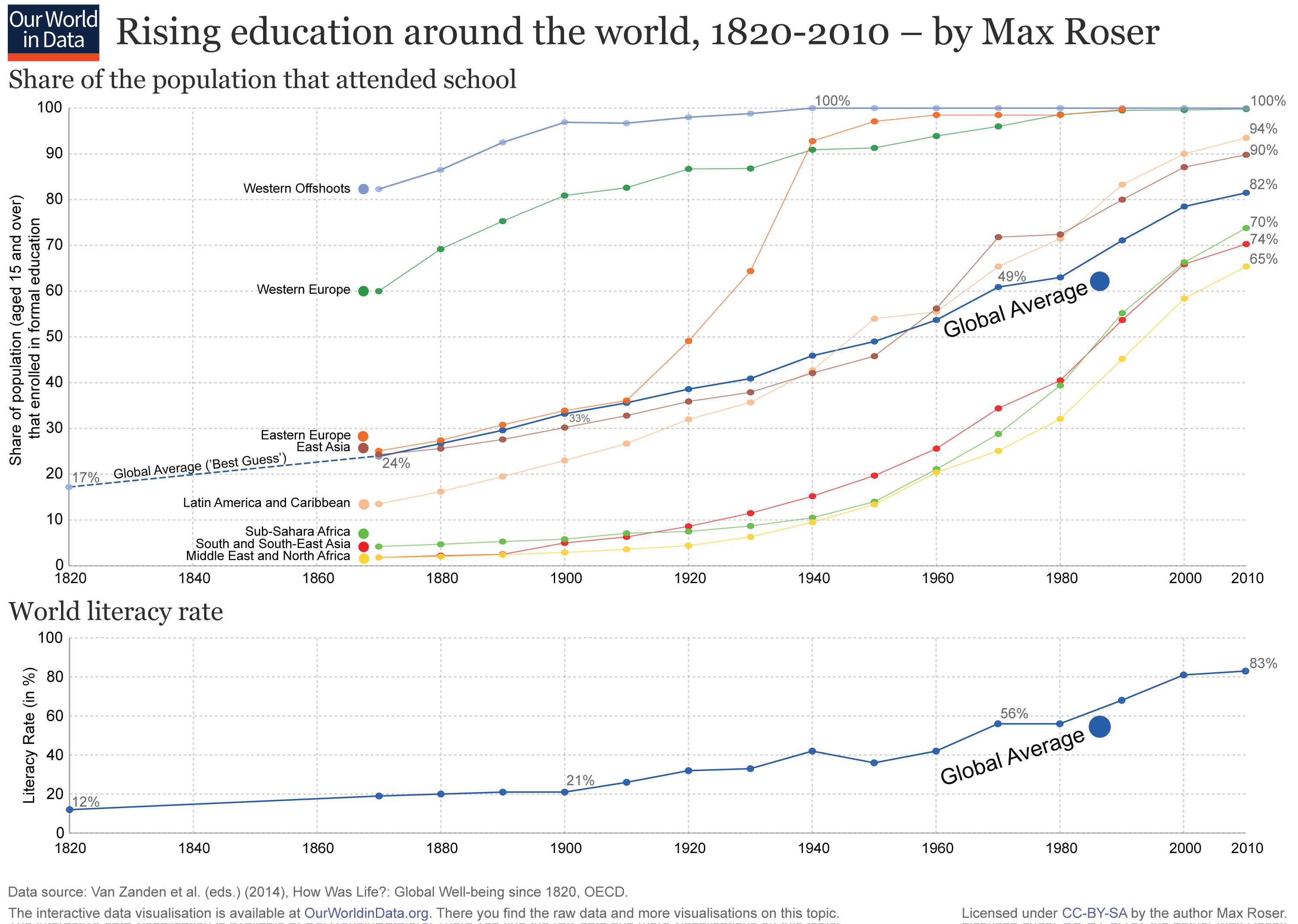
Chart Five -
The Dovetailing of Rising Education with Countries Attaining Advanced Economy Status

In 1870 more than 3 quarters of the world’s people never had the chance to go to school, and only 19% were literate. Let's be clear, these people are destined under capitalism to either unemployment, subsustence living, or doing capital's dirtiest, most drudgerous, dangerous and unpleasant work. The importance of education to the socialist project should barely even need mentioning.

Today, in spite of the massive growth in global population since 1870, those percentages have reversed. 83% of the world's peoples are now literate, almost identical to the global school attendance rate. So capitalism has done socialism's work precisely because the needs of capital and society are not in conflict. Capitalism requires and benefits from an educated workforce, and those workers in turn benefit because the division of labor means that workers can improve their position by acquiring skills that are in relative scarcity, and thereby increase the amount they are able to charge for their labour.

It's less evident here that this is being driven or much accelerated by the processes of globalisation, and that makes some intuitive sense. Where other graphs we've seen "hockey sticking" after the second world war, in line with advancing globalisation, this one offers more of a plateau. The developed world ended the war with literacy levels north of 90%, and took the next forty years to roughly attain full literacy.

The developed world started from a much lower base, but has advanced particularly since the 1960s at a rate that roughly matches long run trend economic growth. The lesson here is clearly that a certain level of economic development is required in order to support a state strong enough to provide comprehensive education to all citizens, but within the span of around a single human lifetime can be transformative to the entire society.

In my next post, I'll turn more specifically to the question of the potential risks and downsides to socialism under global capital. What I've presented here is the "good side" of the story, but as we've seen, unless global capital is otherwise constrained, its operation will tend to increase RELATIVE inequality within and between economies. And that should concern the capitalist set as thoroughly as it should all socialists.

Tuesday, 22 September 2015

Still Obsessing on Modes: Towards a New Socialism Part 2

A response to Tristan Ewins, proprietor of the ALP Socialist Left Forum blog.


I thank Mr, in fact 'Dr' now, it seems ... Tristan Ewins for his reply to my last blog, delivered with considerably more timeliness than I was able to muster. You can read his fulsome  reply HERE. Ewins takes issue with many of my prescriptions for a new socialism.

Ewins wonders why there is any sort of need for a 'new' project at all. To which I would answer there is the need to create a division with an 'old' socialism, very much in the minds of those people we seek to influence.

Let's remember that every socialist state turned into an authoritarian nightmare, and that today many notionally Communist/Socialist states (and that's not a nexus most people have the sophistication to break) are in fact just single-party state Capitalist economies, and those that aren't are basket cases.

Because that's the narrative 'truth' that we need to get beyond in order to render the idea presentable to the Cold War generation.


True: Ford and I agree on the need for “natural public monopolies”.  Ford is not specific, but for me here I think of energy, water, communications and transport infrastructure. I also think of near-monopolies in education.  But why not extend strategic socialisation beyond these strictly conceived boundaries?

Why not? Because you need a rationale for doing so. The idea that the Commonwealth Bank, Telecom Australia or Medibank provide/d some kind of market tempering force for equity within their respective markets is ludicrous. And not borne out by evidence.


The boundaries of government responsibility are what we're talking about, and Ewins rightly questions a number of the definitional boundaries raised by a new socialism. What I would say here is that the mode of analysis is still unnecessarily bound up in binary ideas of public versus private ownership, ie we're focused on the modalities, not the outcomes.


A new socialism should be wholly outcomes-focused. It should NOT see pursuing specific modalities for, say the provision of government services as any sort of inherently socialist project.

The examples Ewins raises include education - where we have mixed funding model, but with public funds often going to private bodies. Neoliberals should be screaming blue murder as much about this situation as they do about rigidities elsewhere in our political system. The new socialist case here would be to ask private schools and education providers to fend for themselves.

Similarly the public subsidy of private health insurance is a complete market perversion. The new socialism should have in mind what could be done with the billion dollar boost axing this would provide the public purse.


Aged Care - similar to education, we have a mixed model. You could argue equity and other outcomes would be improved by wholly public provision, you could argue the private sector is failing to deliver social outcomes completely. 


I wouldn't see government provision of aged care services to be in any way beyond the ambit of a new socialism. In fact, Government provision of services to the community which the market does not of itself adequately provide is a key tenet of the new socialism.


Ewans also raises the question of the mining super-profits tax - and indeed almost says it himself - this is a perfect example of socialisation through regulation rather than through direct ownership. In its original guise, it was the perfect new socialist policy vehicle.


Ewins also raises a number of issues around government support of Co-operative enterprises. I will start by saying that I think this is a very interesting area of activity for socialists IN THEORY. I think workplace democracy and community co-operative models are some of the more interesting tools in the toolbox that we, as socialists haven't properly played with yet.


But I will also say that people have been writing about this stuff since the sixties. And it really never seems to go anywhere. Co-operative enterprises aren't really a real world thing of any consequence right now. I'll set this aside, and say government finding ways to explore new corporate models is a potentially MARKET-LIBERATING activity, if you accept that current corporate structures are detrimentally rigid. Australian innovation in this area has been basically zero, so arguably an example of market failure. Once again, this is how an economist would put it, but she'd be saying fundamentally the same thing as the socialist.

I keep coming back to the point that the language and concepts we use as socialists would actually not be at all alien to a neoliberal. Neoliberalism at its heart makes the same claim as socialism - the maximisation of collective welfare. It's neoliberalism's MODALITIES that are deeply offensive to the socialist instinct.

I actually think the rationalists who want us all to prosper collectively are in the majority in public debate. We simply haven't had the language to talk to each other properly. Finding that language means finding socialism's spirit inherent in all areas of public debate, it means rediscovering socialism not as a revolutionary movement at all, but as a core principle inherent to the democratic instinct.


Ewins then says "Underlying rejections of a larger role for government is the notion that private ownership is “natural”. And on this point I need to be clear - I am NOT advocating a smaller role for government at all. I am advocating a better defined but greatly expanded one.

Ewins is right to say that we shouldn't "fetishise markets", but we need to be equally certain not to pointlessly demonise them either. The line that "neo-liberalism and the impact of market forces on areas of the economy they never had influence on before is the great evil that the modern Left needs to rail against" is lazy in the extreme.

I ask anyone with that analysis to make a list of the actual outcomes they are trying to oppose in one column and their policy prescription for it in the next. I guarantee whatever you map out, it will look nothing like a prescription that "markets are the problem", and "reducing the power of markets is the solution". Instead you'll have a complex set of interacting forces that are crying out for a body to address them. You have a need and a role for government. You don't have a program to "push back neoliberalism", you have a program to work with it to deliver specific agreed outcomes.


And for Ewins, as for myself, it's the definition of these outcomes that becomes crucial to agreeing what the entire socialist project is. And here, we really don't disagree at all.  Equal association, redistribution of wealth, and the creation of a "good society" are all good places to start. But I want something more fundamental, more defining.


Socialism's aim is the delivery of optimal SOCIAL outcomes. That means socialist analysis always occurs at the collective level - anything to do with the advancement of SOCIETY is, or should be its stuff.


What I'm trying to create is a dichotomy between a new socialism, which accepts a defined but expanded role for government, which accepts capitalism as a fundamental and untransgressible force and a revolutionary or utopian socialism that believes in some sort of "post-capitalist" system as if it has any clue what that would remotely even look like.

Thursday, 17 September 2015

Conversations with Mr Corbyn - Towards a New Socialism

Socialists: Have Beard, Will Travel. Picture excludes Luke Foley.

I suppose there comes a time in the life of a blog where it needs to come out from behind its mother's forelocks, be brave and start playing with all the other blogs.

Mr Tristan Ewins, proprietor of the ALP Socialist Left blog, recently posted up some big picture riffing on the question of socialism's mission there, and I did promise him a comprehensive reply in blog form. This is the first part in a series of posts which will attempt to address Tristan, in addressing Kim Carr, in addressing Luke Foley, in squeaky-voice henny-pennying over the edge of a political cliff with all the gravitas of a drowning ballerina.

But I also emerge here in hypothetical conversation with the hashtag of the moment Mr Jeremy Corbyn, whose elevation to the leadership of British Labour has offered socialism the prospect of a real elevation within the spheres of global political discourse.

THIS is an opportune moment that for socialists worldwide must not be missed. Now, the window of history is open enough and allows enough perspective, as divorced from the ideological blinkers that the Cold War fastened us in to, to actually learn history's lessons well,

The trouble, I think with this discussion is that it doesn't go deep enough. The questions here are really "What is Socialism?" and "is the ALP/Labour on a socialist project or not?" The first problem is one of definition, and an extensive exercise at that. The second problem is merely one of ideology once the first is answered.

So let's focus on the first, but I'd like to suggest a unit of analysis even bigger-picture. Because the point of asking these questions is locating from where on the political hillside Labor's light calls to it. The point here is surely not so much to map the present, as chart the future. The light on the hill is as a beacon, not a point of arrival. It guides us forward, rather than telling us where to stop.

"What can socialism be?" and "what COULD it mean for Labor in giving it political purpose?" These are the salient questions to be asking today.

Because we are in a moment, as Bernie Sanders and Jeremy Corbyn have stellarly proven, when suddenly enough time has passed since cold war mores held sway. There is now a generation of particularly younger folk in advanced western economies who are reaching out almost in desperation for a better brand of politics, one that displays considerably more of the heart and the humanism that 20 years of neoliberal discourse has expunged from the system.

There are also a good body of older people for whom the ideas of socialism never died, but were swamped under a sea of pragmatism when the Cold War ended. We all had to concede planned economies don't work, as if THAT was actually a core tenet of socialism that needed shameful jettisoning, and somehow that turned into a repudiation of the discipline, the word, the everything.

With an inescapable cloaking of anyone who went near the concept with all things Stalinist, grey, bleak and inhuman, we conceded effective defeat. And we were desperately wrong to do so.

Wrong, because we let our opponents, as victors, define the history of the battle. But if we can turn now, with 20 years of hindsight and say "Actually the metrics were wrong, the goalposts were never set around massive state ownership and related ideas, or at least they never had to be".

Because we are talking about OBJECTIVES here. How did we ever become so terminally focused on specific processes to attain them? The socialist objective must be to deliver OUTCOMES that adhere to socialist values, rather than known socialist STRUCTURES like state ownership of trading enterprises, whose outcomes do not. And when you start defining things in those terms, you wind up talking about things that actually fold very neatly into economic orthodoxy.

But it's not just we who need to become reconstructed, because the same deep untruths have become gospel to swathes of people who stand outside socialism's discourse. They think they've seen a corpse interred, but they're about to find out they only seeded Lazarus.

Where and when was socialism born? The correct answer is that it's been born and reborn a million times over. Why are we so obsessed by the writings of one German Jew on the matter? Because he ushered in socialism's greatest "modern/pre-modern" upsurge is perhaps understandable, but I feel this resultant obsession with Marxist structures and analytics has been a stright-jacket we've let define the meaning of the movement for too long.

I believe socialism is as much John Lilburne's as it is Karl Marx's to define. Or for that matter, MINE!

Socialism, like basically all great political ideas has its origins concommitant with the fitful birth of British democracy. And the location is no accident, because the conditions that made the land rife for socialism were all the byproducts of early capitalism. In part because England was the most developed economy on earth in its age, because with the complexities of interactions under capitalism, the complexities of the intellectual and public life were advanced also.

Socialism requires profound faculties of analysis - it requires that those at the tail end of a complex series of interactions to have a consciousness of the complete set of discourses they are operating under. It requires that they are able to mentally step outside their own conditions and radically conceive of something better.

It is time for a "New Socialism", one that takes as its foundation the restoration of the very set of values that huge swathes of modern society is clamouring for the political sphere to deliver, but one which has as much in common with ideas like state ownership as it does with laissez-faire capitalism.

It is essential that we succeed in the quest to define a new, post-modern form for socialism, and one which gives real effect to the movement’s long-abiding objectives, albeit through new forms.

Forms that would be completely alien to socialism’s architects and original dreamers, but which are in turn so because the tools I want to talk about ARE very much a product of and accepting of MANY of the precepts of modern, advanced, globalised market capitalism.

I want to disrupt the idea that any of these ideas exist in opposition to socialism. If socialism is the instinct to regulate capitalism, then we have learned some clear lessons about how best to do this.
  • Command economies are stupid. Really, really stupid.
  • This precept extends to government direct intervention in markets through ownership of bodies other than those which are natural monopolies.
  • So the role of government becomes not a tool for intervention in markets, but regulation of them. And provision of services and infrastructure the market would not otherwise provide. And democratic representation in all these areas.
  • And government could be far more aggressive in all these areas, and it’s socialism’s mission to ensure this happens.
  • And in the opinion of this writer it needs to be vastly more aggressive in its pursuit of socialist outcomes, and the feedback to the political system is screaming this at present.
So much of the criticism flung Mr Corbyn's way so far starts with the assumption that these lessons haven't been learned. We have the duty, in seizing the historical moment of opportunity to ensure that they have. We must ask of the likes of Jeremy Corbyn to drive the debate towards a "New Socialism", a globalised, post-modern, post-neoliberal, thoroughly refreshed idea.

Socialism is at its heart nothing more than the inclination to regulate capitalism. The tools to do so have never been more complex, global or powerful. Nor have they been ever more needed.

An exciting new era for socialists sits poised, waiting for us to march towards it. Who else can see this new light on our collective hill?